Central Government salary planning · data checked 19 October 2026
8th Pay Commission Salary Calculator
See what your next salary could look like. Compare five fitment-factor scenarios against your current 7th CPC pay—before you make plans around an amount that has not been officially approved.
Use the free 8th pay commission salary calculator below to estimate projected basic pay, allowances, pension contribution, tax, take-home pay and a what-if arrears total. As of 19 October 2026, the Commission has been constituted, but it has not published its report, an official fitment factor or a final implementation order. Every 8th CPC result on this page is a scenario—not a government figure.
Reference basis: official 7th CPC report/pay matrix and Department of Expenditure orders. The July 2026 DA revision had not been officially announced in the records checked on 19 October 2026.
Your salary estimate, side by side
Change any input; the figures recalculate in your browser.
8वां वेतन आयोग सैलरी कैलकुलेटर — अपनी संभावित नई सैलरी तुरंत जानें।
Expected 8th CPC HRA rates (not official)
These values are user-editable planning assumptions. The actual 8th CPC HRA structure is unknown.
Transport allowance
Use the notified higher-TPTA list applicable to your post. It is not identical to HRA X-city classification. The calculator applies the 7th CPC base TA slab and adds DA; the projected 8th CPC TA is shown with a 0% DA assumption.
7th CPC — current estimate
Estimated monthly in-hand: —
Annual gross: — · Annual estimated tax: —
8th CPC — PROJECTED
Projected monthly in-hand: —
Projected annual gross: — · Annual estimated tax: —
Old vs New tax regime comparison (annual estimate)
| Salary basis | New regime estimated tax | Old regime estimated tax |
|---|---|---|
| Current salary estimate | — | — |
| Projected 8th CPC salary scenario | — | — |
Comparison uses the calculator’s simplified annual salary model. The old-regime deduction field applies only to the old-regime estimate; it does not automatically calculate HRA exemption, every section deduction, age-specific slab or special income. Use an official tax tool or adviser for a filing decision.
Arrears what-if: — based on net monthly gain and your selected implementation date. The effective date and payment of arrears have not been officially notified.
How we calculate the estimates
All calculations run in your browser and use the inputs above. Results are rounded for display and do not replace payroll rules, a tax return or an official pay-fixation order.
HRA = Basic × applicable HRA% ÷ 100
TA = notified base TA + (base TA × DA% ÷ 100)
Gross = Basic + DA + HRA + TA
NPS/UPS employee contribution estimate = 10% × (Basic + DA); OPS employee NPS-style deduction = ₹0 in this simplified model
Projected new basic = current basic × fitment factor, rounded to nearest ₹10
Projected monthly gain = projected net in-hand − current estimated net in-hand
Arrears estimate = monthly gain × full months from chosen effective month until assumed implementation month
The current DA rate is set to 60% based on the 22 April 2026 Department of Expenditure order. Tax uses a simplified FY 2026–27 regime estimate and standard deduction; it excludes full HRA exemption analysis, surcharge, special-rate income, most personal deductions unless you enter old-regime deductions, and age-specific tax treatment. CGHS is assigned by pay level using published contribution bands. Professional tax is entered manually because it depends on state rules. Higher-TPTA city selection is manual.
8th CPC figures are PROJECTIONS based on the selected fitment factor—not government figures. The fitment factor will be known only after the Commission’s report (currently due around May 2027 based on its 18-month mandate) and subsequent government approval.
No registration, account or personal data submission is required. The calculation code runs locally in the page; any browser extensions or website-level analytics outside this calculator are not controlled by this tool.
Download or print the projected 8th Pay Commission pay matrix for planning, then compare it with the current 7th CPC salary calculator and the 8th pay commission fitment factor explainer. The scenario math is deliberately open so readers can inspect the assumptions rather than accept a headline estimate on trust.
How to use the 8th pay commission calculator
The calculator is designed for a phone screen first. You do not need to know an expected 8th CPC fitment factor in advance: start with a familiar current basic, change one assumption at a time, and compare the results side by side. The quick-select post menu can help identify a starting level, but do not treat a designation label as proof of your actual level. Your appointment order, current payslip and applicable service rules take precedence.
- Select your pay level. Choose the 7th CPC level shown on your payslip or service record. The list includes Level 13A separately because it is not the same as Level 13. Use the designation quick-select only as a prompt; roles such as inspector, teacher, railway staff or medical officer may sit at different levels depending on department and cadre.
- Enter your current basic pay. The box starts at the entry value for the selected level. Replace it with the actual cell currently being drawn, not gross pay and not basic plus DA. The official matrix includes annual progression cells; this page also offers a first-three-cells reference table below. If you are in a special pay structure, use your approved pay record instead of forcing a level match.
- Select your HRA city class. Choose X, Y or Z according to the applicable central HRA classification, or “No HRA” if government accommodation or another rule means HRA is not admissible. The current calculation uses 30%, 20% and 10% while DA is above 50%. The projected column uses separate, editable 24%, 16% and 8% assumptions that are not official 8th CPC rates.
- Check current DA. The default is 60%, matching the Department of Expenditure order effective 1 January 2026 located on 19 October 2026. A later DA revision may change the correct number, so edit the field when an official order changes. News predictions alone should not be entered as a notified rate.
- Choose a fitment scenario. Tap one of the presets or move the slider from 1.00 to 4.00. This lets you see what different multipliers would do to the same salary. There is no officially selected 8th CPC fitment factor; the preset names are sensitivity scenarios, not a probability forecast.
- Read the current and projected results. Compare gross pay, estimated contribution deductions, CGHS, entered professional tax, estimated annual tax, net in-hand, monthly gain, percentage change and arrears what-if. Gross is before deductions; net is only an estimate after the deductions represented here. The model does not know your full payroll, loan recovery, insurance, local tax or personal tax exemptions.
What each output line means
Basic: current pay-matrix basic or projected basic after the selected multiplier. DA: a percentage of basic under the current structure; the 8th CPC scenario assumes 0% only because a reset is a useful illustration. HRA: basic multiplied by the selected city-class rate. TA: base transport allowance plus DA where applicable, using the published 7th CPC slabs and a manual higher-TPTA switch. Gross: basic, DA, HRA and TA added together. NPS/UPS: a simplified employee-contribution estimate; OPS shows no employee NPS-style contribution in the model. CGHS: the pay-level-based contribution band. TDS: monthly share of estimated annual tax. Net in-hand: gross less modelled deductions. Gain and hike: projected net minus current estimated net, then expressed as a percentage of the current estimate.
हिंदी में 6 चरण: पहले अपना पे-लेवल चुनें। फिर वास्तविक बेसिक पे भरें। अपनी HRA सिटी-क्लास और वर्तमान DA दर जाँचें। इसके बाद फिटमेंट फैक्टर चुनें—यह केवल अनुमान है। दोनों कॉलम में ग्रॉस, कटौती, टैक्स और नेट इन-हैंड की तुलना करें। अंत में संभावित एरियर देखें; इसे सरकारी मंजूरी या निश्चित भुगतान न समझें।
What is the 8th Pay Commission? Current status and timeline
The Central Pay Commission is a temporary expert body that studies the pay, allowances, pension and related service conditions of Central Government employees and makes recommendations for government consideration. The 8th Central Pay Commission follows the 7th CPC, whose revised pay matrix took effect from 1 January 2016. It matters to employees because a new commission can change the basic-pay structure and allowance rules, and to pensioners because retirement benefits and pension revision form part of the wider review.
The Commission’s work is relevant to civil services, many Central Government departments, railways and eligible defence personnel under their applicable pay rules. The scale of the affected population is often described in government announcements as around 50 lakh serving employees and around 69 lakh pensioners; exact counts can vary by date and by whether particular categories are included. State employees, public-sector employees, teachers, CAPF personnel and other groups should check their own governing rules. Central recommendations do not automatically change every state, PSU or separately governed service on the same date.
The Union Cabinet approved the terms of reference on 28 October 2025, and the Gazette notification establishing the Commission followed on 3 November 2025. The terms of reference ask the Commission to consider the country’s economic situation, fiscal prudence, resources for development and welfare, unfunded non-contributory pension costs, the financial effect on state governments, and the current emoluments and working conditions in public-sector undertakings and private employment. In other words, the final recommendation cannot be inferred from a fitment-factor demand alone.
The Commission’s official portal shows a working consultation calendar. It lists a memorandum-response deadline extended to 15 June 2026 and regional/state visits during 2026. These meetings are part of consultation, not evidence that a pay matrix has already been approved. The official portal listed a Jaipur visit for 31 August–1 September, Chandigarh for 16–18 September and Bengaluru for 7–8 October. Its latest notice checked for this page lists Mumbai on 22–23 October 2026. Dates and deadlines below reflect posted notices rather than unverified claims about the outcome of meetings.
Confirmed milestones and dates to watch
| Milestone | Date / current position | What it means |
|---|---|---|
| Government announcement | 16 January 2025 | Announcement that an 8th CPC would be formed; not an approval of salary rates. |
| Terms of reference approved | 28 October 2025 | Cabinet approved the scope and conditions of the Commission’s work. |
| Commission constituted | 3 November 2025 | Official notification established the Commission and its 18-month reporting mandate. |
| Memorandum deadline | Extended to 15 June 2026 | The Commission invited submissions; the extended deadline has passed. |
| Jaipur consultation | 31 Aug–1 Sep 2026 | Visit listed on the official Commission portal. |
| Chandigarh consultation | 16–18 Sep 2026 | Visit listed on the official Commission portal. |
| Bengaluru consultation | 7–8 Oct 2026 | Visit listed; no unposted outcome is inferred here. |
| Mumbai consultation | 22–23 Oct 2026 | Upcoming in the official notice checked 19 October 2026. |
| Report due window | Around May 2027, approximate | 18 months from constitution; subject to an official extension or other order. |
| Implementation | Not notified | Late 2027 is a public guess, not a confirmed date. Any arrears start date also needs an order. |
PIB’s October 2025 release said the effect of the 8th CPC recommendations would “normally” be expected from 1 January 2026, following the usual ten-year pattern. That is useful context, but it is not a government guarantee of a January 2026 implementation date or arrears. The final effective date, the release date, and the date employees start receiving a revised monthly amount may not be identical.
Latest news and official notices
Last updated: 19 October 2026. The most useful freshness signal is the date on a primary order, not a social media claim or an unlabelled salary chart. These updates are dated and linked so readers can verify the underlying notice.
- 21 Sep 2026: The 8th CPC portal posted a notice for the Commission’s Mumbai visit on 22–23 October 2026; the notice lists 10 October as the response deadline for that visit. Open source notice/report.
- 24 Aug 2026: The official portal listed the Bengaluru visit scheduled for 7–8 October 2026. The dates have now passed; this page does not infer what was discussed without a published outcome. Open source notice/report.
- 11 Aug 2026: The Commission posted a partial modification to consultant-engagement guidelines. This is administrative progress, not a published fitment factor or salary matrix. Open source notice/report.
- 29 May 2026: The Commission extended the deadline for memorandum responses to 15 June 2026. That submission window has closed. Open source notice/report.
- 19 Oct 2026 status check: The latest DoE DA order located in official records still sets 60% from 1 January 2026. News reports published 16–17 October said a July 2026 revision announcement had not yet been made; do not substitute a reported 63% expectation for an official order. Open source notice/report.
The July 2026 DA revision is a separate issue from the 8th CPC. As of this check, the official DA order list still showed the 60% rate effective from 1 January 2026; some news reports expected another increase, but that expectation must not be represented as an announced rate. Recheck the Department of Expenditure order list before changing a current-pay assumption.
Primary references: 8th CPC official portal, PIB: Cabinet approves 8th CPC terms of reference, 28 October 2025, and Department of Expenditure: DA OM effective 1 January 2026.
8th Pay Commission pay matrix: projected basic pay under five scenarios
The fitment factor is a multiplier used in discussion of how current basic pay might translate into a revised basic amount. A simple illustration is projected new basic = current basic × selected fitment factor. However, the ultimate method could include a new matrix, rounding rules, revised cells, pension-specific provisions and other policy decisions. A multiplier alone cannot predict exact fixation for every employee.
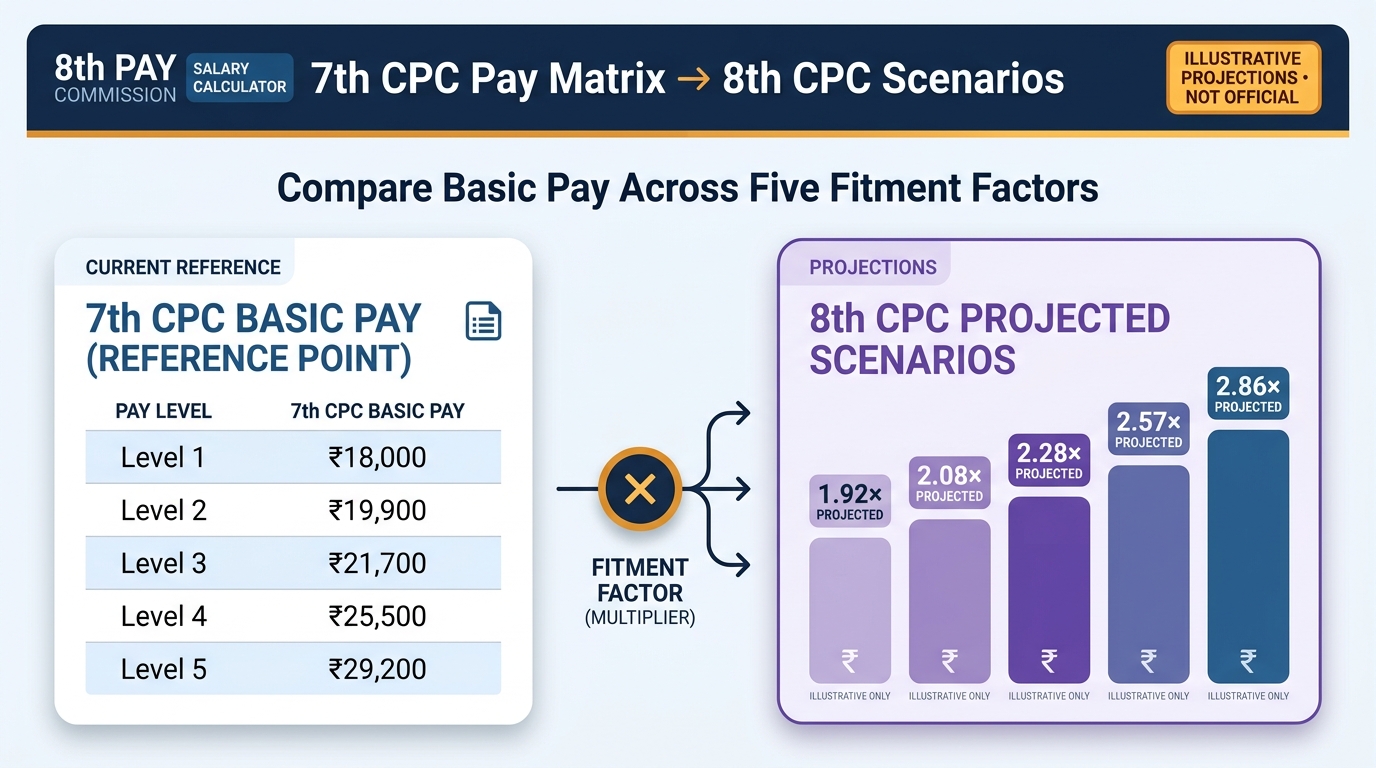
There is no official 8th CPC factor. To make the calculator useful without pretending to know the Commission’s answer, this table applies five clearly labelled hypothetical multipliers to 7th CPC entry basics. The scenarios are planning comparisons: 1.92 is a low-case number circulated in discussions (sometimes labelled “consensus” without an official consensus); 2.08 is an alternative optimistic illustration; 2.28 is a mid-case example; 2.57 mirrors the 7th CPC multiplier as a thought experiment; 2.86 is a higher-case number discussed in some demand/commentary. No scenario is approved by the Commission. Staff-side or union demands of 3.833 or 4.0 are demands, not government decisions, and are not used as official values here.
All scenario figures below are projected as of 19 October 2026. Values are rounded to the nearest ₹10 for the table’s arithmetic; actual government fixation may use exact matrix cells and different rounding/fixation rules. The listed data covers 19 rows because Level 13A is a separate pay level alongside Levels 1–18.
| Level | 7th CPC entry basic | 1.92 × projected basic | 2.08 × projected basic | 2.28 × projected basic | 2.57 × projected basic | 2.86 × projected basic |
|---|---|---|---|---|---|---|
| Level 1 | ₹18,000 | ₹34,560 | ₹37,440 | ₹41,040 | ₹46,260 | ₹51,480 |
| Level 2 | ₹19,900 | ₹38,210 | ₹41,390 | ₹45,370 | ₹51,140 | ₹56,910 |
| Level 3 | ₹21,700 | ₹41,660 | ₹45,140 | ₹49,480 | ₹55,770 | ₹62,060 |
| Level 4 | ₹25,500 | ₹48,960 | ₹53,040 | ₹58,140 | ₹65,540 | ₹72,930 |
| Level 5 | ₹29,200 | ₹56,060 | ₹60,740 | ₹66,580 | ₹75,040 | ₹83,510 |
| Level 6 | ₹35,400 | ₹67,970 | ₹73,630 | ₹80,710 | ₹90,980 | ₹101,240 |
| Level 7 | ₹44,900 | ₹86,210 | ₹93,390 | ₹102,370 | ₹115,390 | ₹128,410 |
| Level 8 | ₹47,600 | ₹91,390 | ₹99,010 | ₹108,530 | ₹122,330 | ₹136,140 |
| Level 9 | ₹53,100 | ₹101,950 | ₹110,450 | ₹121,070 | ₹136,470 | ₹151,870 |
| Level 10 | ₹56,100 | ₹107,710 | ₹116,690 | ₹127,910 | ₹144,180 | ₹160,450 |
| Level 11 | ₹67,700 | ₹129,980 | ₹140,820 | ₹154,360 | ₹173,990 | ₹193,620 |
| Level 12 | ₹78,800 | ₹151,300 | ₹163,900 | ₹179,660 | ₹202,520 | ₹225,370 |
| Level 13 | ₹123,100 | ₹236,350 | ₹256,050 | ₹280,670 | ₹316,370 | ₹352,070 |
| Level 13A | ₹131,100 | ₹251,710 | ₹272,690 | ₹298,910 | ₹336,930 | ₹374,950 |
| Level 14 | ₹144,200 | ₹276,860 | ₹299,940 | ₹328,780 | ₹370,590 | ₹412,410 |
| Level 15 | ₹182,200 | ₹349,820 | ₹378,980 | ₹415,420 | ₹468,250 | ₹521,090 |
| Level 16 | ₹205,400 | ₹394,370 | ₹427,230 | ₹468,310 | ₹527,880 | ₹587,440 |
| Level 17 | ₹225,000 | ₹432,000 | ₹468,000 | ₹513,000 | ₹578,250 | ₹643,500 |
| Level 18 | ₹250,000 | ₹480,000 | ₹520,000 | ₹570,000 | ₹642,500 | ₹715,000 |
Official 7th CPC pay matrix: entry pay and first three cells
For readers who want to check the base inputs, the following reference table provides the first three published pay cells for each pay level. For Level 13, use the modified matrix issued by the Department of Expenditure in September 2017, which changed its entry cell from ₹1,18,500 to ₹1,23,100 with effect from 1 January 2016. Levels 17 and 18 are fixed-pay levels in this reference, so they do not have three progression cells to display.
| 7th CPC level | Cell 1 / entry | Cell 2 | Cell 3 | |
|---|---|---|---|---|
| Level 1 | ₹18,000 | ₹18,000 | ₹18,500 | ₹19,100 |
| Level 2 | ₹19,900 | ₹19,900 | ₹20,500 | ₹21,100 |
| Level 3 | ₹21,700 | ₹21,700 | ₹22,400 | ₹23,100 |
| Level 4 | ₹25,500 | ₹25,500 | ₹26,300 | ₹27,100 |
| Level 5 | ₹29,200 | ₹29,200 | ₹30,100 | ₹31,000 |
| Level 6 | ₹35,400 | ₹35,400 | ₹36,500 | ₹37,600 |
| Level 7 | ₹44,900 | ₹44,900 | ₹46,200 | ₹47,600 |
| Level 8 | ₹47,600 | ₹47,600 | ₹49,000 | ₹50,500 |
| Level 9 | ₹53,100 | ₹53,100 | ₹54,700 | ₹56,300 |
| Level 10 | ₹56,100 | ₹56,100 | ₹57,800 | ₹59,500 |
| Level 11 | ₹67,700 | ₹67,700 | ₹69,700 | ₹71,800 |
| Level 12 | ₹78,800 | ₹78,800 | ₹81,200 | ₹83,600 |
| Level 13 | ₹123,100 | ₹123,100 | ₹126,800 | ₹130,600 |
| Level 13A | ₹131,100 | ₹131,100 | ₹135,000 | ₹139,100 |
| Level 14 | ₹144,200 | ₹144,200 | ₹148,500 | ₹153,000 |
| Level 15 | ₹182,200 | ₹182,200 | ₹187,700 | ₹193,300 |
| Level 16 | ₹205,400 | ₹205,400 | ₹211,600 | ₹217,900 |
| Level 17 | ₹225,000 | ₹225,000 | — | — |
| Level 18 | ₹250,000 | ₹250,000 | — | — |
Official references: Department of Expenditure: 7th CPC report and pay matrix and DoE OM modifying Level 13, 28 September 2017.
Worked example: Level 7 with current basic ₹44,900
At a 1.92 scenario, ₹44,900 × 1.92 = ₹86,208 before rounding. If the displayed planning model rounds to the nearest ₹10, the projected basic is ₹86,210. Today, with 60% DA, ₹44,900 + ₹26,940 DA = ₹71,840 basic-plus-DA. Comparing ₹86,208 projected basic with ₹71,840 current basic-plus-DA gives a basic-plus-DA increase of about 20%, before changes in allowances, contributions and tax. The difference is not 92% because today’s DA already adds 60% on top of basic pay.
Use the fitment scenario table as an orientation tool, not an entitlement letter. An eventual pay matrix might preserve some existing entry relationships, introduce new cells, modify Level 13/13A structures, use a different factor for specific circumstances, or set distinct arrangements for defence services and other groups. The commission’s accepted recommendations and detailed government rules—not a web calculator—will decide how pay is fixed in an individual case.
7th CPC vs 8th CPC: what is known and what is only projected
The 7th CPC is an operating structure supported by published rules and orders. The 8th CPC is still a review process. A direct comparison is useful, but every forward-looking item in the right column below is an assumption until notified. This is especially important for allowances: a new basic-pay structure does not necessarily mean every allowance percentage or deduction remains unchanged.
| Item | 7th CPC current reference (as at 19 Oct 2026) | 8th CPC scenario — not official |
|---|---|---|
| Minimum basic | ₹18,000 at Level 1 entry | At 1.92 scenario, ₹34,560 from ₹18,000; other scenarios differ. No new minimum approved. |
| Maximum basic | ₹2,50,000 at Level 18 | Unknown; a multiplier-only example is not a maximum pay decision. |
| Fitment | 2.57 was approved for the 7th CPC revision with its own rules | Not announced; selectable factors here are sensitivity scenarios. |
| DA | 60% from 1 January 2026 under the latest official order located | 0% reset assumption used for comparison; actual treatment awaits orders. |
| HRA | 30% / 20% / 10% for X / Y / Z when DA exceeds 50%, under applicable orders | 24% / 16% / 8% editable example only, not notified rates. |
| Transport allowance | 7th CPC base slabs plus applicable DA | Held at the same base slab with 0% DA solely for scenario comparison. |
| NPS / UPS | Employee deductions and employer contribution depend on scheme and applicable rules | No 8th CPC contribution rules published; current-style contribution is a simplified estimate. |
| Pension | Existing pension and family-pension rules apply to eligible cohorts | Projected 50% basic pension / 30% family pension illustration only; final provisions unknown. |
| Effective date | 7th CPC pay structure operates from 1 January 2016, subject to fixation orders | 1 January 2026 was described by PIB as normally expected based on past practice; not a notified implementation or arrears guarantee. |
The biggest known difference is therefore not a precise rupee increase. It is the certainty of the current rules versus the uncertainty of a commission that has yet to report. For now, employees can verify current basic pay, DA, HRA, transport allowance, CGHS deduction, tax and retirement contributions using official documents. They cannot reliably treat a reported factor or social-media “final salary matrix” as a salary entitlement.
When recommendations arrive, the government will need to decide which parts to accept, the effective date, how existing pay is mapped to a revised structure, how allowances are adjusted, and how arrears are calculated and paid. Some groups—including defence personnel, railway employees and specific autonomous bodies—may have separate implementing orders. State Governments decide their own adoption and may adjust dates or provisions. This is why a general online calculator is a scenario aid and not a replacement for DDO or accounts-office fixation.
The 7th CPC’s 2.57 multiplier also should not be treated as proof that 2.57 will recur. That previous factor was part of a particular pay-revision calculation, and the design included pay-matrix cell movement, DA integration and allowance changes. An apparently large basic-pay jump can coexist with a much smaller real rise after considering current DA and the reset assumptions.
DA, HRA and transport allowance: rates, rules and examples
Dearness Allowance (DA)
DA is intended to help offset changes in the cost of living. For 7th CPC employees, the notified percentage is applied to basic pay as defined in the applicable pay rules. The government considers the Consumer Price Index for Industrial Workers (CPI-IW/AICPI-IW) and announces revisions periodically, typically with effect from 1 January and 1 July. The index helps inform the decision, but the rate payable is the one in an applicable government order, not an unofficial index-to-percentage guess.
The latest official DA order located for this page was the Department of Expenditure OM dated 22 April 2026: it increased DA from 58% to 60% with effect from 1 January 2026. The next July 2026 revision was reported in the press as pending on 16–17 October 2026; until an official OM is published, the calculator must not silently change this input to a reported expectation. Pensioners’ Dearness Relief (DR) is a related but separate order stream, and individual defence/railway employees may require department-specific orders.
| Effective period | DA rate for 7th CPC pay | Department of Expenditure OM date |
|---|---|---|
| 1 Jan 2026 | 60% | 22 Apr 2026 |
| 1 Jul 2025 | 58% | 6 Oct 2025 |
| 1 Jan 2025 | 55% | 2 Apr 2025 |
| 1 Jul 2024 | 53% | 21 Oct 2024 |
| 1 Jan 2024 | 50% | 12 Mar 2024 |
| 1 Jul 2023 | 46% | 20 Oct 2023 |
Worked DA example (current, 60% effective from 1 Jan 2026): on ₹44,900 basic, DA = ₹44,900 × 60 ÷ 100 = ₹26,940. Basic plus DA is ₹71,840. When the rate changes through a new official order, the DA component changes even if basic pay does not. The calculator’s DA input should therefore be refreshed against the latest DoE circular before use.
Official source: DA revision OM effective 1 January 2026. Index background: Labour Bureau, Ministry of Labour & Employment.
House Rent Allowance (HRA)
HRA supports eligible employees who live in rented accommodation, subject to applicable conditions. Under the 7th CPC implementation order, the baseline rates for X/Y/Z cities were 24%/16%/8%; the order provides upward revisions when DA crosses stated thresholds, culminating in 30%/20%/10% when DA crosses 50%. As the notified DA is 60% effective from January 2026, the current-rate assumption used here is 30% for X, 20% for Y and 10% for Z. HRA is generally calculated on basic pay, not basic plus DA.
| City class | Current HRA rate (DA above 50%) | 8th CPC scenario rate (not official) | Examples / note |
|---|---|---|---|
| X | 30% | 24% expected | Mumbai, Delhi (UA), Kolkata (UA), Chennai (UA), Bengaluru, Hyderabad, Pune (UA) |
| Y | 20% | 16% expected | Examples include Chandigarh, Jaipur, Lucknow, Patna, Bhopal, Coimbatore, Kochi, Nagpur and Visakhapatnam; check official Annexure for exact UA status |
| Z | 10% | 8% expected | Other eligible cities/towns not classified X or Y |
| No HRA | 0% | 0% scenario input | Government accommodation / cases where HRA is not admissible |
The official Annexure classifies particular cities and urban agglomerations into X and Y. Examples of X classifications include Greater Mumbai, Delhi (UA), Chennai (UA), Kolkata (UA), Bengaluru, Hyderabad and Pune (UA). Examples of Y cities include Jaipur, Lucknow, Chandigarh, Patna, Nagpur and Coimbatore; the exact status must be checked against the official city list and any special notes (including dependent-city rules). Places not listed as X or Y generally fall into Z. A city’s popularity, population or metro status does not by itself establish its HRA classification.
Worked HRA example: at ₹44,900 basic in an X-class city, current HRA at 30% is ₹13,470 per month. The projected 8th CPC input of 24% would yield ₹10,776 on the simple projection basic of ₹44,900 before fitment—or approximately ₹20,690 on a projected ₹86,210 basic. The second number is only the arithmetic consequence of an assumed 24% HRA and a 1.92 fitment scenario; no new HRA rate has been notified.
Source: DoE HRA OM and city-classification annexure, 7 July 2017.
Transport Allowance (TA)
Transport allowance uses pay-level bands and higher rates for specifically notified higher-TPTA cities. Under the published 7th CPC schedule, Levels 1–2 have base rates of ₹1,350 in higher-TPTA cities and ₹900 elsewhere; Levels 3–8 have ₹3,600 and ₹1,800; Level 9 and above have ₹7,200 and ₹3,600. Eligible TA is DA-indexed, so the current calculation adds 60% to the base TA. The official-car option that may apply to eligible Level 14+ officers has separate conditions and is not automatically represented by the general TA slab.
| Pay-level band | Higher-TPTA cities (monthly base TA) | Other places (monthly base TA) |
|---|---|---|
| Pay Levels 1–2 | ₹1,350 | ₹900 |
| Pay Levels 3–8 | ₹3,600 | ₹1,800 |
| Pay Level 9 and above | ₹7,200 | ₹3,600 |
| Eligible Level 14+ official-car option | ₹15,750 + DA where applicable | Subject to relevant order and option |
Worked TA example: a Level 7 employee outside a higher-TPTA city has a ₹3,600 base TA. At 60% DA, the illustrated total is ₹3,600 + ₹2,160 = ₹5,760 per month. In the projected 8th CPC comparison, the same base TA is held constant while DA is set to zero, giving ₹3,600 in this simplified scenario. That does not forecast whether the Commission will maintain or revise TA.
Source: 7th CPC allowances / transport-allowance recommendations and relevant DoE implementing orders. A higher-TPTA city is not necessarily an HRA X city, so verify the applicable list before using that input.
DA merger myth: why your hike is not automatically 92%
A fitment factor is not the same thing as a net salary-increase percentage. Employees already receive DA on top of basic pay, so part of the economic adjustment is already reflected in current pay. If a hypothetical new pay structure replaces current basic-plus-DA with a new basic and resets DA to zero, the true basic-plus-DA comparison should use the current total—not just current basic—as the denominator.
Consider a Level 7 employee at ₹44,900 basic and 60% DA. Current DA is ₹26,940, so current basic plus DA is ₹71,840. Under a hypothetical 1.92 multiplier, ₹44,900 × 1.92 = ₹86,208 projected new basic before the calculator’s ₹10 display rounding. The difference is ₹14,368, or about 20% of ₹71,840. Saying the salary rises by 92% ignores the 60% DA already being paid. This is a before-allowances and before-tax illustration; net in-hand can be different because HRA, TA, pension contribution and taxes may also change.
A useful mental model is: fitment factor ≈ (1 + the DA proportion being absorbed) × (1 + the real basic-plus-DA increase). If 60% DA is treated as the amount to be absorbed, then 1.92 ≈ 1.60 × 1.20, which implies about a 20% increase in that simplified comparison. This is explanatory arithmetic, not the official 8th CPC pay-fixation formula. The Commission may recommend a different factor and matrix rules.
Illustrative real-rise comparison — scenario figures
| Sample level | Current basic | Current basic + 60% DA | 1.92 projected scenario | 2.28 projected scenario | 2.57 projected scenario |
|---|---|---|---|---|---|
| Level 1 | ₹18,000 | ₹28,800 | 1.92× → ₹34,560 projected; 20.0% basic-plus-DA rise | 2.28× → ₹41,040 projected; 42.5% basic-plus-DA rise | 2.57× → ₹46,260 projected; 60.6% basic-plus-DA rise |
| Level 7 | ₹44,900 | ₹71,840 | 1.92× → ₹86,210 projected; 20.0% basic-plus-DA rise | 2.28× → ₹102,370 projected; 42.5% basic-plus-DA rise | 2.57× → ₹115,390 projected; 60.6% basic-plus-DA rise |
| Level 10 | ₹56,100 | ₹89,760 | 1.92× → ₹107,710 projected; 20.0% basic-plus-DA rise | 2.28× → ₹127,910 projected; 42.5% basic-plus-DA rise | 2.57× → ₹144,180 projected; 60.6% basic-plus-DA rise |
The table treats the current reference as basic plus 60% DA, and compares it with projected new basic at 0% DA. For the 1.92 factor the arithmetic implies a 20.0% rise in basic-plus-DA; for 2.28 it implies 42.5%; for 2.57 it implies about 60.6%. These numbers do not model inflation between now and implementation, changes to allowance policy, NPS/UPS treatment, tax, or differences between a multiplier and actual revised pay-matrix cell placement.
There has also been recurring discussion of a “DA merger” or payment of 18 months of DA arrears. These are separate issues. A DA rate revision changes the ongoing payable percentage under a published order; a DA merger would need a formal policy decision; pandemic-period deferred DA/DR instalments and any claimed arrears require their own government decision. As of 19 October 2026, this page has not located an official order announcing a DA merger or guaranteeing a payment of 18 months of DA arrears. Do not add these amounts to projected salary or personal commitments until a relevant order exists.
8th CPC arrears calculator: estimate months × monthly gain
Arrears depend on two things that are not settled here: the effective date the government ultimately approves and the date revised pay is implemented in payroll. Some employees may receive arrears after the revised pay is fixed; the approved period, payment schedule, deductions, tax treatment and any interest or special treatment will depend on the government’s orders. The tool below uses the monthly net gain from your main calculator and counts full calendar months between an assumed effective month and your chosen implementation month. Change the date to compare scenarios.
If the assumed implementation date is on or before the effective month, the estimate is zero. This simple calculation counts full month units, does not model partial months or salary-stage fixation and does not subtract likely arrears tax or contribution changes.
What the arrears figure does—and does not—mean
For example, if your estimated net gain is ₹10,000 per month and a hypothetical 21 full months of arrears are payable, the raw scenario is ₹10,000 × 21 = ₹2,10,000 before adjustments. The amount is only a planning illustration. A real calculation could use gross pay rather than net gain, have separate DA or allowance arrears, account for interim increments, change the revised basic in each month, and apply tax in the year or years when arrears are paid.
The 7th CPC experience is often cited because revised pay was implemented with effect from 1 January 2016 and arrears were later paid under government decisions. It does not establish a legal guarantee that every future commission will use the same effective date, cutoff, time horizon or payout rules. PIB’s statement that the new Commission’s effect would normally be expected from 1 January 2026 is contextual, not a final arrears order.
Arrears may increase taxable salary in the year of receipt, and section 89 relief or related mechanisms may be relevant depending on circumstances and applicable tax law. Do not assume all arrears are taxed in the same way for every employee; consult the official tax rules and your accounts office when an actual order is issued. A payroll office may also have to recalculate HRA, TA, pension contributions, professional tax, loan recoveries or other deductions for past months.
18 months of DA arrears: do not confuse this slogan with 8th CPC pay arrears. Any release related to withheld pandemic-period DA/DR would require a separate confirmed government decision; the 8th CPC report, fitment factor and arrears tool do not prove that those past amounts will be paid.
8th Pay Commission pension calculator: pension and family-pension projections
Pensioners and family pensioners are an important part of pay-commission coverage. The official terms of reference allow the Commission to consider pension and retirement benefits, but this does not settle how the 8th CPC will revise pension. Current pension depends on the applicable service/pension rules, last emoluments or average emoluments, qualifying service, pension type, retirement date, commutation and other circumstances. Family pension has its own eligibility conditions and ordinary/enhanced rates.
The following small module uses a simplified illustration: projected last/basic pay is the selected current basic multiplied by the fitment scenario; an illustrative basic pension is 50% of that projected pay and an ordinary family-pension estimate is 30%. This is not a claim that the Commission will use that exact formula for everyone. The calculator’s minimum pension comparison starts from the current ₹9,000 minimum basic pension reference and multiplies by the scenario; actual minimums and revision formula are undecided.
Projected pension illustration (not an entitlement)
Projected minimum pension sensitivity from ₹9,000 × factor: —. This is a mechanical scenario only; do not use it for pension sanction, commutation or a bank application.
Dearness Relief (DR) applies to eligible pensioners under separate orders and normally moves with DA revision policy, but the rate and treatment at the time a new CPC structure is implemented must be checked against the applicable DR order. Commutation rules affect the monthly amount received and potential restoration timing; this page does not calculate commuted pension or survivor-specific entitlements. A family-pension estimate should never be treated as a claim approval.
NPS vs UPS vs OPS in the 8th CPC context
NPS: a defined-contribution retirement arrangement for covered employees. Employee and employer contributions, investment returns and exit rules shape the benefit; an online projection cannot guarantee retirement income. UPS: the Unified Pension Scheme is available to eligible Central Government employees under notified eligibility and option rules, with contribution and assured-payout provisions that must be read in the actual scheme terms. OPS: the older defined-benefit pension framework remains relevant to eligible cohorts under applicable rules. Do not switch or elect based on projected 8th CPC basic pay alone—compare qualifying service, retirement horizon, family support, commutation, contribution record and the current official scheme documents with your pension cell.
For serving employees, the calculator uses a simplified 10% employee contribution estimate on basic plus DA for NPS/UPS choices and zero NPS-style deduction for OPS. It does not calculate government contribution as extra take-home pay and does not assess individual UPS eligibility. For pensioners, no employee NPS deduction is applied by the module. Verify with the pension-disbursing authority and your DDO before making a formal decision.
Frequently asked questions about the 8th Pay Commission
These answers were reviewed on 19 October 2026. Any 8th CPC salary, factor, pension, HRA rate or arrears number remains a projection until it appears in a government recommendation that is accepted and implemented through formal orders.
Is the 8th Pay Commission implemented?
No. As checked on 19 October 2026, the 8th Central Pay Commission has been constituted and is conducting its work, but a final report, notified fitment factor, revised pay matrix and implementation order have not been published. Every 8th CPC number on this page is a projection.
When will the 8th Pay Commission be implemented?
There is no officially notified implementation date. The Commission has 18 months from its constitution on 3 November 2025 to submit its report, which points to around May 2027; Cabinet consideration and implementation would follow separate decisions.
What is the expected fitment factor?
No official factor has been announced. This calculator offers illustrative 1.92, 2.08, 2.28, 2.57 and 2.86 multipliers so that you can compare outcomes, not because the Commission has endorsed those numbers.
How much salary increase can I expect?
It depends on the eventual fitment factor, revised matrix cells, DA reset, HRA, transport allowance, pension contribution, tax and individual deductions. The calculator displays a scenario-specific estimated monthly net change; it is not a guaranteed raise percentage.
How is 8th CPC salary calculated in this calculator?
The projection begins with your chosen 7th CPC basic pay, multiplies it by your selected fitment factor and rounds the result to the nearest ₹10. It then applies editable projected HRA assumptions, a 0% DA scenario and simplified TA, pension-contribution and tax calculations.
Will DA become zero after the 8th CPC?
A new pay commission commonly resets DA when revised pay is introduced, but the 8th CPC has not issued its recommendations. The calculator assumes 0% DA only as a scenario; it is not an official decision.
Will pensioners benefit from the 8th CPC?
Pensions and retirement benefits fall within the Central Pay Commission’s broad remit, and the Commission’s terms of reference mention retirement benefits. The exact pension formula, eligibility and implementation details remain undecided until recommendations and orders are published.
What will be the minimum salary after the 8th CPC?
No minimum revised basic pay has been notified. For illustration only, multiplying today’s ₹18,000 entry basic by the selectable factors produces different projected values; actual fixation may use a revised pay matrix rather than a simple multiplier.
Will arrears be paid from January 2026?
That is not guaranteed. PIB said the effect would normally be expected from 1 January 2026 based on the usual ten-year pattern, but a final effective date and arrears order are not published. Treat the arrears tool as a what-if estimate.
How do I know my HRA city class?
Use your department’s applicable Department of Expenditure HRA city/town annexure and any later updates. X/Y classification may depend on the officially listed urban agglomeration and specific notes; remaining eligible places generally fall in Z. Your HRA class is not automatically the same as a transport-allowance city class.
Is NPS mandatory for every government employee?
Coverage depends on appointment date, service, employer, cadre and applicable pension rules; there are eligible employees under different arrangements. UPS is an option for eligible Central Government NPS-covered employees subject to the notified rules, while OPS applies to defined cohorts. Ask your DDO or pension authority before changing choices.
How is income tax estimated here?
The tool estimates annual salary tax using a simplified FY 2026–27 slab model, standard deduction and the resident-individual rebate rules applicable to the selected regime. It does not fully model HRA exemption, all deductions, special-rate income, surcharge, age-specific old-regime slabs or individual tax credits, so compare with a tax professional or official calculator.
What is the CGHS deduction?
The calculator uses the published monthly contribution bands of ₹250 for Levels 1–5, ₹450 for Level 6, ₹650 for Levels 7–11 and ₹1,000 for Level 12 and above. Eligibility and deductions may differ by employment and healthcare arrangement, so verify your payslip and CGHS instructions.
Can I change the fitment factor?
Yes. Select one of the five scenario buttons or move the custom slider between 1.00 and 4.00. This is a sensitivity-testing feature; it does not imply that any selected factor is official or more likely to be adopted.
Are the calculator results official?
No. The 7th CPC entry-pay references and the cited allowances are based on official documents, but every 8th CPC salary, pension, HRA and arrears result is an estimate derived from your inputs. Only government notifications and approved pay-fixation orders determine an actual entitlement.
What is the difference between the 7th and 8th CPC?
The 7th CPC is the operative pay structure based on its pay matrix, allowances and orders. The 8th CPC is a commission established to review pay, allowances and pensions; until its recommendations are accepted, its figures and structure are unknown.
Will HRA rates change under the 8th CPC?
The new Commission may recommend allowance changes, but no official 8th CPC HRA rates have been issued. Values of 24%, 16% and 8% shown here are editable planning assumptions, not approved rates.
What about State Government employees?
The 8th Central Pay Commission directly concerns Central Government pay structures. State Governments may study or adopt central recommendations with state-specific modifications and dates; a central calculator cannot promise a State employee’s future salary.
Does the 8th CPC cover Gramin Dak Sevaks (GDS)?
Do not assume that a Central Pay Commission pay matrix automatically applies to GDS. Their engagement and compensation framework differs, and coverage must be confirmed from official Department of Posts orders. This calculator is designed around 7th CPC pay levels, not a GDS-specific pay scale.
What is a pay matrix?
The 7th CPC pay matrix is the structured table of basic-pay levels and annual progression cells that replaced the earlier pay-band and grade-pay arrangement for covered employees. This page shows first cells for reference and multiplies the selected basic by scenarios for projection; it does not invent an official 8th CPC matrix.
Who is the 8th Pay Commission chairperson?
The official 8th CPC portal names Smt. Justice Ranjana Prakash Desai as chairperson, Prof. Pulak Ghosh as part-time member and Shri Pankaj Jain as member-secretary. See the official composition page for the current roster.
When is the 8th CPC report due?
The terms of reference say the Commission is to make recommendations within 18 months of its constitution. Given constitution on 3 November 2025, that points to approximately May 2027, subject to any official extension or further government action.
Can I use projected salary for a loan application?
No lender should be given a projected 8th CPC amount as if it were guaranteed income. Use your current salary certificate, payslips and official documents, and treat any projection as personal planning only.
How should I compare the old and new tax regimes?
Compare tax using your complete annual salary and eligible deductions, exemptions, HRA rent details, investments and family circumstances. This calculator supplies a rough side-by-side estimate; the simplified old-regime option may omit important exemptions and can therefore differ materially from your actual tax computation.
8वां वेतन आयोग कब लागू होगा?
अभी तक 8वें केंद्रीय वेतन आयोग की लागू होने की अंतिम तारीख की आधिकारिक घोषणा नहीं हुई है। आयोग 3 नवंबर 2025 को गठित हुआ था और उसे रिपोर्ट देने के लिए 18 महीने दिए गए हैं; इसलिए मई 2027 के आसपास रिपोर्ट आने की समय-सीमा बनती है, लेकिन लागू होने की तारीख अलग सरकारी निर्णय से तय होगी।
फिटमेंट फैक्टर क्या है?
फिटमेंट फैक्टर वह गुणक है जिसे वर्तमान बेसिक पे से गुणा करके संभावित नया बेसिक अनुमानित किया जाता है। 8वें वेतन आयोग का आधिकारिक फिटमेंट फैक्टर अभी घोषित नहीं हुआ है; इस पेज पर 1.92 से 2.86 तक के विकल्प केवल अनुमान हैं, सरकारी आदेश नहीं।
8वां वेतन आयोग सैलरी कैलकुलेटर — हिंदी में
यह 8वां वेतन आयोग सैलरी कैलकुलेटर आपकी वर्तमान 7वें वेतन आयोग की बेसिक पे के आधार पर संभावित नई बेसिक सैलरी का अनुमान दिखाता है। इसमें 1.92, 2.08, 2.28, 2.57 और 2.86 जैसे फिटमेंट फैक्टर चुन सकते हैं। ये सभी केवल उदाहरण/प्रोजेक्शन हैं; 8वें केंद्रीय वेतन आयोग ने अभी आधिकारिक फिटमेंट फैक्टर, नई पे मैट्रिक्स या अंतिम सैलरी स्लैब घोषित नहीं किया है।
19 अक्टूबर 2026 तक आधिकारिक Department of Expenditure रिकॉर्ड में मिला नवीनतम DA आदेश 1 जनवरी 2026 से 60% महंगाई भत्ता तय करता है। जुलाई 2026 के DA संशोधन के बारे में खबरों में अनुमान आया, लेकिन आधिकारिक आदेश मिले बिना 63% जैसी दर को पक्का न मानें। 8वें वेतन आयोग का गठन 3 नवंबर 2025 को हुआ और उसकी अध्यक्ष न्यायमूर्ति रंजना प्रकाश देसाई हैं। आयोग को गठन की तारीख से 18 महीने में रिपोर्ट देने के लिए कहा गया है, इसलिए रिपोर्ट की अनुमानित समय-सीमा लगभग मई 2027 बनती है। यह लागू होने की पक्की तारीख नहीं है।
कैलकुलेटर में अपना Pay Level और वास्तविक Basic Pay चुनें/भरें, X/Y/Z शहर के अनुसार HRA क्लास चुनें, वर्तमान DA दर की पुष्टि करें और अपनी पसंद का फिटमेंट फैक्टर चुनें। इसके बाद वर्तमान अनुमानित ग्रॉस सैलरी, कटौतियाँ, टैक्स, नेट इन-हैंड और अनुमानित 8वें CPC कॉलम की तुलना करें। 24%/16%/8% HRA तथा 0% projected DA केवल परीक्षण के लिए हैं; ये सरकारी रूप से स्वीकृत दरें नहीं हैं।
8वां वेतन आयोग सैलरी कैलकुलेटर in Hindi का उद्देश्य आपको अलग-अलग परिस्थितियों में योजना बनाने में मदद करना है। “कितनी सैलरी बढ़ेगी”, “8वां वेतन आयोग कब लागू होगा”, “फिटमेंट फैक्टर क्या होगा” और “एरियर जनवरी 2026 से मिलेगा या नहीं” जैसे सवालों का अंतिम जवाब तभी मिलेगा जब आयोग की रिपोर्ट, सरकार की स्वीकृति और लागू करने के आदेश जारी होंगे। 1 जनवरी 2026 से एरियर मिलना अभी निश्चित नहीं है।
किसी भी लोन, निवेश, खर्च या रिटायरमेंट का फैसला projected salary को वास्तविक आय मानकर न करें। वर्तमान वेतन के लिए अपनी payslip, सेवा नियम और DDO/Accounts Office को प्राथमिकता दें। नई दरें प्रकाशित होने पर पेज की तारीख और आधिकारिक स्रोत जाँचें।
What to do now: a practical financial-planning checklist
- Keep commitments anchored to current income. Do not take a loan, sign a property contract or increase recurring expenses because a projected 8th CPC figure looks attractive. Lenders assess actual payslips and official salary documents, not a calculator scenario.
- Download your current records. Retain recent payslips, current pay-level/cell confirmation, annual tax statement, CGHS deduction record and pension contribution statement. Reconcile the DA percentage against the latest Department of Expenditure order and any applicable department-specific instruction.
- Review NPS/UPS/OPS on their own rules. Do not assume a new pay commission will make one retirement system best for every person. Check your eligibility, service, contribution history, retirement age, family-pension conditions and option deadlines from the official scheme guidance or pension cell.
- Compare old and new tax regimes with real data. Enter realistic annual earnings, eligible deductions, HRA/rent details and other income in an authoritative tax tool. The estimator here is a rough guide and may omit tax details that materially affect your liability.
- Track official announcements, not forwarded screenshots. Watch the 8th CPC portal for report and consultation notices, the Department of Expenditure for DA/HRA/TA orders, PIB for Cabinet decisions, and the Labour Bureau for CPI-IW data. Date-stamp any projection you save.
- Ask your DDO or accounts office before acting. When an approved pay-fixation order is issued, ask how your level, cell, personal pay, allowances, contribution deductions and arrears will be determined. For pensioners, confirm pension and DR separately with the pension-disbursing authority.
The safest use of a projected salary calculator is to compare scenarios, identify questions and prepare a conservative budget. It cannot decide which pay level is legally due, whether a special allowance is admissible, whether a pension formula applies to a specific retirement date, or how tax relief will be claimed. If the Commission publishes interim recommendations, read whether the relevant items are final, interim, accepted by Government or still under consultation.
Disclaimer: All 8th CPC salary, pension, HRA, arrears and fitment values displayed here are projections and not official figures. The 8th CPC has not published a final pay matrix or fitment factor as of 19 October 2026. Verify current DA, HRA and TA rates against date-stamped government orders; confirm eligibility, tax, deductions and pay fixation with your DDO, accounts office or pension authority. This site is an informational calculator, not an official Government of India service and not financial, legal or tax advice.
Correction policy: Found an error? Figures are corrected within 24 hours after verification against an applicable primary source. Every table or projection should be read with its “as of” date and the assumptions stated next to it.

Editorial role: government salary-rules research and calculator methodology; tracking official pay commission updates since 2025.
Method: primary government notifications are preferred for pay rates; projection inputs are separated from confirmed rules. This is an editorial desk label, not a claim of government affiliation.
CGHS contribution reference
CGHS subscription is a defined contribution by pay-level band for eligible beneficiaries; it is not the same as a tax or an NPS contribution. The current calculator assigns the published 7th CPC slab by pay level, but individual applicability can depend on beneficiary status and the relevant scheme arrangements. Confirm the current subscription instruction if your department has an exception or separate arrangement.
| 7th CPC pay level | Monthly CGHS contribution |
|---|---|
| Levels 1–5 | ₹250 |
| Level 6 | ₹450 |
| Levels 7–11 | ₹650 |
| Level 12 and above | ₹1,000 |
Source: Ministry of Health & Family Welfare: CGHS subscription OM.
Central Pay Commission history: first to eighth
Past commissions show that pay revisions are multi-stage processes: constitution, report, Cabinet consideration, rules/orders, pay fixation and allowance updates. They do not reveal the next fitment factor by themselves. The first six figures below are historical summaries from published references; minimum-pay concepts, price levels and pay structures changed substantially, so direct comparisons across decades should not be read as like-for-like purchasing-power comparisons. For the 8th CPC, “not decided” is the only responsible description for new official pay values.
| Commission | Constituted / announced | Effective from | Minimum monthly basic | Formula / fitment | Chairperson |
|---|---|---|---|---|---|
| 1st CPC | May 1946 | 1947 | ₹55/month | No modern pay-matrix factor | Justice Srinivasa Varadachariar |
| 2nd CPC | August 1957 | 1959 | ₹80/month | Pay-scale revision; no directly comparable matrix factor | Justice Jagannadha Das |
| 3rd CPC | April 1970 | 1 January 1973 (implementation chronology varies by component) | ₹196/month as implemented (reported recommendation: ₹185) | Pay-scale revision; no directly comparable matrix factor | Justice Raghubir Dayal |
| 4th CPC | 1983 | 1 January 1986 | ₹750/month | Revised pay scales; not comparable to 7th CPC factor | Justice P. N. Singhal |
| 5th CPC | April 1994 | 1 January 1996 | ₹2,550/month | Scale conversion/revised scales; no single comparable modern matrix factor | Justice S. Ratnavel Pandian |
| 6th CPC | 2006 | 1 January 2006 | ₹7,000/month | 1.86 fitment concept; pay bands + grade pay | Justice B. N. Srikrishna |
| 7th CPC | February 2014 | 1 January 2016 | ₹18,000/month | 2.57 factor plus a new pay matrix; Level 13 later modified | Justice A. K. Mathur |
| 8th CPC | January 2025 announcement; constituted 3 November 2025 | Not notified; 1 January 2026 was described by PIB as the normal expected effect date based on past pattern | Not decided; ₹18,000 × scenario is only a projection | No official fitment factor published | Justice Ranjana Prakash Desai |
Historical context sources include the PIB record on earlier pay commissions and the Department of Expenditure Central Pay Commission repository. Past implementation dates are context, not a promise of future timing.
Related salary tools
Use these dedicated calculators and salary references for more focused calculations. Each link points only to a page in the site map provided for this homepage.
For any pay matrix PDF or report, begin with the official 7th CPC reference documents and the 8th CPC’s own portal. Do not treat a downloaded projected matrix as a notified pay order.