Home › 7th CPC Salary Calculator
Central Government salary · 7th CPC pay matrix
7th Pay Commission Salary Calculator
Your exact in-hand salary in 30 seconds. Pick your pay level and cell, choose your city — get basic, DA, HRA, TA, NPS and take-home pay, itemised.
This free 7th pay commission salary calculator uses the official 7th CPC pay matrix (all 19 levels, every cell), the current 60% DA (DoE order effective 1 January 2026), and the notified HRA and transport allowance slabs. Below the tool you get the full matrix, allowance rules, pay-fixation examples, deductions, a salary-slip walkthrough and 22 FAQs — everything on one page.
7th CPC salary calculator
Change any input; the figures recalculate instantly in your browser.
7वां वेतन आयोग सैलरी कैलकुलेटर — अपना पे-लेवल और सेल चुनें, DA, HRA, TA और NPS कटौती के साथ इन-हैंड सैलरी तुरंत जानें।
Monthly salary break-up
Your in-hand salary
- Annual gross (approx)—
- Employer NPS contribution (info)—
Last updated: 19 October 2026 · Rates: DA 60% (DoE OM 22 Apr 2026) · HRA 30/20/10 · TA slabs per 7th CPC · NPS 10%/14% · CGHS bands as notified. Verify against your DDO/PAO slip — this tool is an estimate.
How it’s calculated (formulas)
HRA = Basic × HRA% ÷ 100 (30/20/10; minimums 5400/3600/1800; 0 if govt quarters)
TA base: Level 9+ → X/Y 7200, Z 3600 · Level 1–8 → X/Y 3600, Z 1800
TA paid = TA base × (1 + DA% ÷ 100)
Gross = Basic + DA + HRA + TA paid
NPS employee = 10% × (Basic + DA) · NPS employer = 14% × (Basic + DA)
Net = Gross − NPS employee − CGHS − tax estimate (if enabled)
Matrix cell rule: cell(n) = round(cell(n−1) × 1.03 ÷ 100) × 100
Check: Level 7 cell 1, Y city, 60% DA → Basic 44,900 + DA 26,940 + HRA 8,980 + TA 5,760 = Gross 86,580; NPS 7,184; Net ≈ 79,396 before CGHS (650) and tax.
New to central government pay? Start with the 7th pay commission salary calculator above, then read how each allowance works below. If you are tracking the next revision, see our 8th pay commission salary calculator and the fitment factor explainer; the current DA rate page keeps the 60% figure date-stamped.
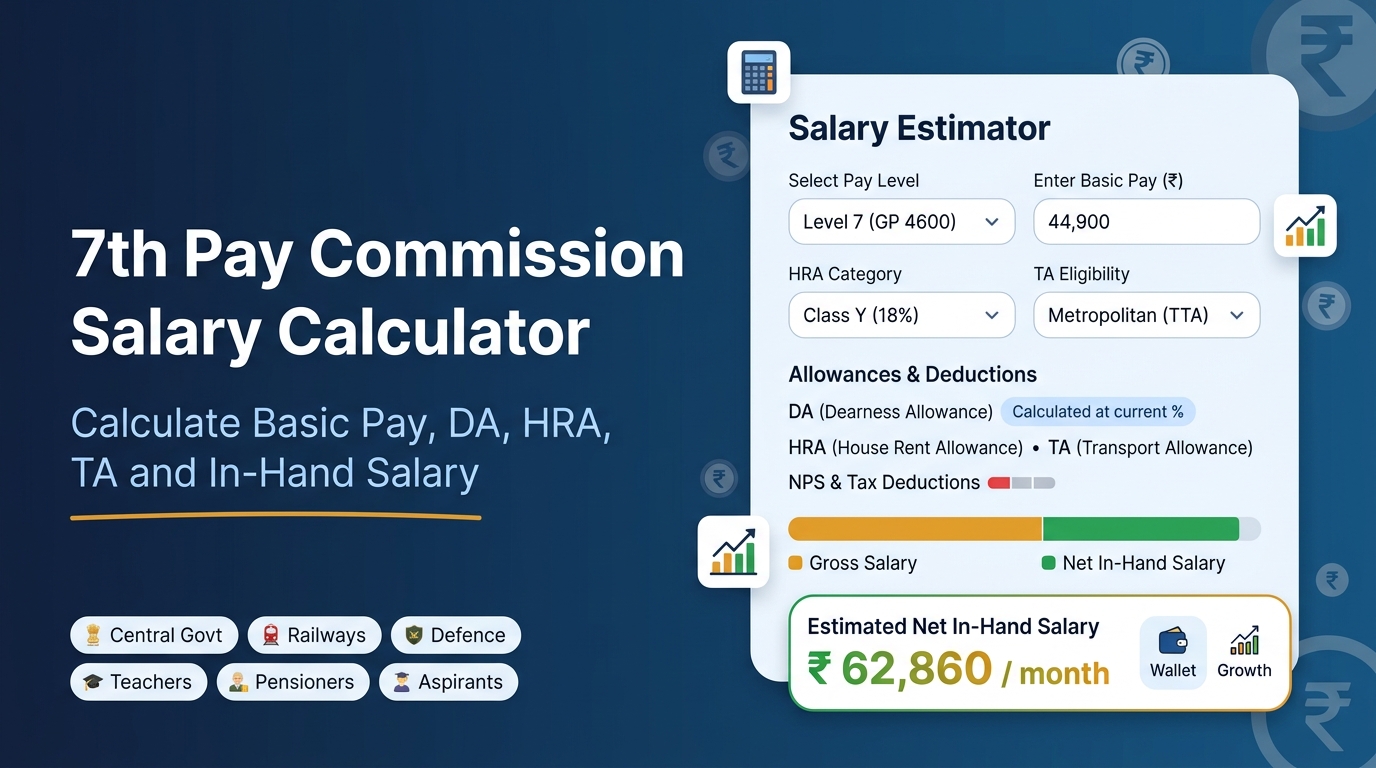
How to use the 7th pay commission salary calculator
Follow these steps with your payslip or appointment letter in hand. The whole thing takes under a minute, and every figure recalculates the moment you change an input.
- Select your pay level (1–18 or 13A). Your payslip shows this as “Pay Level”. If your appointment letter still mentions an old grade pay, use the mapping table in Section 4 — for example, Grade Pay ₹4,200 means Level 6. When in doubt, the level on your latest salary slip is the correct one.
- Choose your matrix cell (stage). Cell 1 is the entry pay of your level. Each annual increment moves you exactly one cell down the row. A concrete example: an Assistant Section Officer at Level 7, cell 5, posted in a Y city — select Level 7, then cell 5, and the basic pay fills in automatically as ₹52,000 (verify against your slip).
- Check the basic pay box. It auto-fills from your level and cell, but you can type your exact basic if your slip shows a slightly different figure. The calculator will tell you which matrix cell is nearest to a custom value, so you always know where you stand.
- Pick your city class: X, Y or Z. This decides your HRA rate (30%, 20% or 10%). Use the city where you are actually posted, per your department’s HRA classification — not your hometown. If you live in government accommodation, tick the quarters checkbox and HRA becomes zero.
- Confirm the DA%. It is pre-set to 60%, the latest official rate (effective 1 January 2026). Change it only when a new DoE order is published — the July 2026 revision was still unannounced as of 19 October 2026.
- Review TA, NPS and CGHS. Transport allowance is set automatically from your level and city, plus DA on TA. NPS deducts 10% of (Basic + DA) when switched on; uncheck it if you are under the Old Pension Scheme. CGHS fills from the notified slab for your level.
- Read the results. The left card shows every component line by line — basic, DA, HRA, TA, gross, then each deduction. The right card shows your net in-hand salary as the hero number, plus approximate annual gross and your employer’s NPS contribution for information.
Where does the result appear? Directly below the inputs, in the two result cards — no page reload, no submit button. On a phone, scroll slightly down after changing inputs; the cards update live. Use the Print button to save a clean copy for your records.
What the calculator doesn’t cover (honest limits)
No calculator knows your full payroll. This one excludes: overtime and night-duty allowance, deputation allowance, special duty allowance for Northeast postings, risk/hardship allowances, uniform-related allowances beyond dress allowance, honorarium, and recoveries (GPF/CPF subscriptions, festival advance, house-building advance, licence fee). If any of these apply, add them to the gross (or deductions) from your slip manually. The tool also doesn’t model leave encashment or bonus — those are annual, not monthly.
हिंदी में: अपना पे-लेवल और सेल चुनें, शहर की श्रेणी (X/Y/Z) चुनें, और DA दर जाँचें — आपकी बेसिक पे, DA, HRA, TA अपने आप जुड़ेंगे और NPS व CGHS कटकर इन-हैंड सैलरी तुरंत दिखेगी।
What is the 7th Pay Commission?
The 7th Central Pay Commission (7th CPC) is the body whose recommendations decide the current salary structure of central government employees. It was constituted on 25 September 2013, submitted its report on 19 November 2015, and the government approved it on 29 June 2016 with effect from 1 January 2016. Revised allowances — HRA, transport allowance and others — were implemented from July 2017.
Its headline change was the 2.57 fitment factor: every employee’s 6th CPC basic (pay in the pay band plus grade pay) was multiplied by 2.57 to arrive at the new pay. The minimum basic pay became ₹18,000 per month and the maximum ₹2,50,000 (Apex scale). Just as important, the commission abolished the old pay-band-plus-grade-pay system and replaced it with a single pay matrix — a clean table of levels and cells that anyone can read without knowing what “PB-2” meant.
The 7th CPC covers roughly 47–50 lakh serving central government employees and a similar number of pensioners, including civilian staff, railway employees and defence personnel under their respective pay rules. State governments adopted it separately with their own orders and dates. If you joined central government service any time after 1 January 2016, your entire pay career so far has run on this matrix — the calculator above simply reads it back to you.
Key events timeline
| Date | Event |
|---|---|
| 25 Sep 2013 | 7th Central Pay Commission constituted |
| 19 Nov 2015 | Commission submits its report to the government |
| 29 Jun 2016 | Cabinet approves the recommendations; pay effective 1 Jan 2016 |
| 25 Jul 2016 | Resolution and pay rules notified; pay fixed at 2.57× of 6th CPC basic |
| Aug 2016 | Arrears for 1 Jan 2016 – 31 Jul 2016 paid in one instalment |
| Jul 2017 | Revised allowance orders issued (HRA, TA and others) |
| Jan 2024 | DA crosses 50%; HRA revised upward to 30/20/10% |
| 18 Apr 2026 | Cabinet approves DA 58% → 60% w.e.f. 1 Jan 2026 |
| 22 Apr 2026 | DoE issues the implementation OM for 60% DA |
The fitment factor page explains how the 2.57 multiplier worked in 2016 — and what a future factor might look like. For the allowance that changes your salary twice a year, see the DA calculator.
Who is covered by the 7th CPC — and who isn’t
The 7th CPC is a Central Government pay structure. It directly covers civilian central government employees, railway servants, and defence personnel (under their respective pay rules), plus central government pensioners through Dearness Relief. Roughly 47–50 lakh serving employees and over 65 lakh pensioners fall under it.
State government employees are not automatically covered. Each state issues its own pay revision orders — many mirrored the 7th CPC with the same 2.57 fitment, but with different effective dates, DA rates and allowance structures. If you work for a state government, your state finance department’s orders override everything on this page.
PSU employees follow separate pay scales (IDA/CDA patterns) — the 7th CPC matrix does not apply to them. Bank employees are governed by bipartite settlements with their own DA formula. Teachers in central universities follow UGC pay scales (academic levels 10–15), which parallel but don’t equal the CPC matrix. Gramin Dak Sevaks have their own TRCA-based structure. If none of these exceptions apply to you and your appointment letter mentions a CPC pay level, this page — and the calculator — is built for you.
Full 7th CPC pay matrix (7th pay matrix table)
The pay matrix is the heart of the 7th CPC. Read it like a grid: each row is a pay level (your rank in the hierarchy) and each column is a cell (your seniority within that level). Your basic pay is simply the figure where your row and column meet. There are 19 rows — Levels 1 to 18 plus a separate Level 13A — and up to 40 cells per row. Level 18 is the exception: a single fixed cell of ₹2,50,000.
Every annual increment moves you exactly one cell to the right at 3%: each cell is the previous cell multiplied by 1.03, rounded to the nearest ₹100. That is the only maths behind the entire table — no separate increment tables to memorise. On promotion you move to a new row (see Section 7), and under MACP you can move rows even without a promotion.
Level 13 deserves a note: its entry pay of ₹1,23,100 reflects the September 2017 modification (the original 2016 cell was lower). Level 13A (₹1,31,100 entry) is a distinct row for certain posts — do not confuse it with Level 13. The calculator and the table below keep them separate.
Entry pay, maximum pay and old grade pay by level
| Level | Entry basic (Cell 1) | Maximum basic | Old grade pay |
|---|---|---|---|
| 1 | 18,000 | 56,900 | 1,800 |
| 2 | 19,900 | 63,200 | 1,900 |
| 3 | 21,700 | 69,100 | 2,000 |
| 4 | 25,500 | 81,100 | 2,400 |
| 5 | 29,200 | 92,300 | 2,800 |
| 6 | 35,400 | 1,12,400 | 4,200 |
| 7 | 44,900 | 1,42,400 | 4,600 |
| 8 | 47,600 | 1,51,100 | 4,800 |
| 9 | 53,100 | 1,67,800 | 5,400 (PB-2) |
| 10 | 56,100 | 1,77,500 | 5,400 (PB-3) |
| 11 | 67,700 | 2,08,700 | 6,600 |
| 12 | 78,800 | 2,09,200 | 7,600 |
| 13 | 1,23,100 | 2,15,900 | 8,700 |
| 13A | 1,31,100 | 2,16,600 | 8,900 |
| 14 | 1,44,200 | 2,18,200 | 10,000 |
| 15 | 1,82,200 | 2,24,100 | — (HAG) |
| 16 | 2,05,400 | 2,24,400 | — (HAG+) |
| 17 | 2,25,000 | 2,32,500 | — (HAG+) |
| 18 | 2,50,000 | 2,50,000 (fixed) | — (Apex) |
Complete pay matrix — every level × every cell
Scroll sideways to find your exact cell. This is the same dataset the calculator above uses, generated by the official 3%-per-cell rule from the notified entry pays.
Grade pay → level mapping (for old appointment letters)
| Old grade pay (₹) | 7th CPC level | Note |
|---|---|---|
| 1,800 | Level 1 | Entry basic ₹18,000 |
| 1,900 | Level 2 | |
| 2,000 | Level 3 | |
| 2,400 | Level 4 | |
| 2,800 | Level 5 | |
| 4,200 | Level 6 | Common for inspectors, station masters |
| 4,600 | Level 7 | Common for ASOs, section officers |
| 4,800 | Level 8 | |
| 5,400 (PB-2) | Level 9 | Check your pay band — same GP splits here |
| 5,400 (PB-3) | Level 10 | Group A entry; see our Level 10 pay scale guide |
| 6,600 | Level 11 | |
| 7,600 | Level 12 | |
| 8,700 | Level 13 | |
| 8,900 | Level 13A | Distinct row — not the same as Level 13 |
| 10,000 | Level 14 |
Popular posts by pay level
Post-to-level mapping varies by department and recruitment rules — treat these as common examples, then confirm against your appointment order.
| Post | Usual level | Entry basic (₹) |
|---|---|---|
| MTS, Railway Group D | Level 1 | 18,000 |
| LDC / Junior Secretariat Assistant | Level 2 | 19,900 |
| UDC, Tax Assistant, Stenographer Gr. D | Level 4 | 25,500 |
| Railway Station Master, Senior Clerk | Level 6 | 35,400 |
| ASO (CSS), Inspector (CBIC/CBN), Section Officer | Level 7 | 44,900 |
| Assistant Audit Officer | Level 8 | 47,600 |
| Entry-level Group B gazetted | Level 9 | 53,100 |
| IAS/IPS/IFS entry, Group A services | Level 10 | 56,100 |
Deep dives: Level 6 pay scale · Level 9 pay scale · Level 10 pay scale
Salary components explained: basic pay, DA, HRA, transport allowance
Your monthly salary is not one number — it is a stack of components, each with its own rule. Understand the stack and you can verify any salary slip in a minute.
Basic pay
Basic pay is the figure from the pay matrix for your level and cell. Everything else is calculated on basic pay, so it is the foundation. When someone says “Level 7”, they mean a basic-pay row that starts at ₹44,900 — the allowances then sit on top of whichever cell you have reached.
Dearness Allowance (DA)
DA protects your salary against inflation. It is a percentage of basic pay, revised twice a year (effective 1 January and 1 July) based on the 12-month average of the Labour Bureau’s All-India Consumer Price Index for Industrial Workers (AICPI-IW). The formula: DA% = [(average AICPI − 261.42) ÷ 261.42] × 100. The current rate is 60%, effective 1 January 2026. The July 2026 instalment had not been officially announced as of 19 October 2026, though news reports expected about 63% — keep the calculator’s DA field editable and never treat a prediction as the rate. Track it on our DA calculator page.
House Rent Allowance (HRA)
HRA is a percentage of basic pay decided by your city class. Because DA crossed 50% in January 2024, the current rates are X cities 30%, Y cities 20%, Z areas 10%, with minimums of ₹5,400 / ₹3,600 / ₹1,800 per month. The rate follows a threshold table — when DA was lower, HRA was lower too:
| DA level | X city | Y city | Z area |
|---|---|---|---|
| DA below 25% | 24% | 16% | 8% |
| DA 25% – 50% | 27% | 18% | 9% |
| DA above 50% (current) | 30% | 20% | 10% |
Example: at Level 7 cell 1 (₹44,900 basic) in a Y city, HRA = 20% × 44,900 = ₹8,980 — above the ₹3,600 minimum, so ₹8,980 is paid. Posted to Delhi, Mumbai or another X city? HRA jumps to 30% = ₹13,470. Living in government quarters? HRA is zero and a licence fee is recovered instead.
Which cities are X, Y and Z?
City class follows the Department of Expenditure’s HRA classification, based on urban agglomeration population. The X cities (highest HRA) are:
| City / Urban Agglomeration | HRA rate |
|---|---|
| Delhi (NCT) | 30% |
| Mumbai (UA) | 30% |
| Kolkata (UA) | 30% |
| Chennai (UA) | 30% |
| Bengaluru (UA) | 30% |
| Hyderabad (UA) | 30% |
| Ahmedabad (UA) | 30% |
| Pune (UA) | 30% |
Y cities (20% HRA) are roughly 44 cities with population above 5 lakh — including Jaipur, Lucknow, Kanpur, Nagpur, Indore, Bhopal, Patna, Surat, Ludhiana, Agra, Coimbatore, Kochi, Thiruvananthapuram and others per the DoE list. Everything else is Z (10%). Important: your HRA city class and your TA city class can differ — TA uses the separate higher-TPTA city list. Always go by your department’s current classification annexure, not by what the city “feels like”.
Transport Allowance (TA)
TA is a fixed monthly amount decided by your level and city, and — unlike HRA — DA is also paid on TA at the prevailing rate. Current slabs:
| Level | X / Y city base | With 60% DA | Z area base | With 60% DA |
|---|---|---|---|---|
| Level 9 and above | ₹7,200 | ₹11,520 | ₹3,600 | ₹5,760 |
| Level 1 – 8 | ₹3,600 | ₹5,760 | ₹1,800 | ₹2,880 |
A notified list of higher-TPTA cities gets the upper rate; the calculator has a checkbox for it. Employees with certain disabilities can draw double TA under the applicable orders — check your department’s rules.
DA revision history (7th CPC era)
DA started at 0% in January 2016 (it merged into the new basic) and has been revised every six months since — except the COVID freeze of 2020–21, when three instalments were withheld and then restored together at 28% in July 2021:
| Effective from | DA rate | Note |
|---|---|---|
| Jan 2016 | 0% | 7th CPC implementation; DA merged into basic |
| Jul 2016 | 2% | |
| Jan 2017 | 4% | |
| Jul 2017 | 5% | |
| Jan 2018 | 7% | |
| Jul 2018 | 9% | |
| Jan 2019 | 12% | |
| Jul 2019 | 17% | |
| Jan 2020 – Jan 2021 | 17% (frozen) | COVID freeze; three instalments withheld |
| Jul 2021 | 28% → 31% | Freeze lifted at 28%; further 3% approved Oct 2021 (both w.e.f. 1 Jul 2021) |
| Jan 2022 | 34% | |
| Jul 2022 | 38% | |
| Jan 2023 | 42% | |
| Jul 2023 | 46% | |
| Jan 2024 | 50% | HRA revised to 30/20/10% |
| Jul 2024 | 53% | |
| Jan 2025 | 55% | |
| Jul 2025 | 58% | Announced 1 Oct 2025 |
| Jan 2026 | 60% (current) | Announced 18 Apr 2026 |
| Jul 2026 | ~63%? (expected, not announced) | AICPI-IW points to ~3% hike; Cabinet approval pending as of 19 Oct 2026 |
How DA is computed from AICPI — worked example
Take the July 2026 instalment as an illustration. The Labour Bureau’s AICPI-IW for July 2025–June 2026 averaged about 148.65 (base 2001 = 100). Apply the formula: (148.65 − 261.42) ÷ 261.42 × 100 ≈ 63.7%. Fractions are dropped, giving 63% — a 3-point rise over the current 60%. At Level 1 (₹18,000 basic), each DA point is worth ₹180/month, so the expected hike means ₹540 more per month once notified, with arrears from 1 July 2026. Until the Cabinet approves it, though, 60% remains the only official rate — which is why the calculator defaults there.
Other allowances (one line each — then the two worth knowing)
NPA (Non-Practising Allowance) for medical officers at 20% of basic, within the ceiling. HPCA/PCA (Hospital/Patient Care Allowance) for eligible hospital staff. Dress allowance paid yearly to entitled categories. Two allowances deserve more than a line because almost every employee with children or travel claims them:
Children Education Allowance (CEA): ₹2,250 per month per child (maximum two children), plus a hostel subsidy of ₹6,750 per month where applicable. It is claimed yearly with school certificates — it doesn’t appear on the monthly slip the way DA does, so many employees forget to factor it into annual income planning. Divyang children attract double the rate under the relevant orders.
Leave Travel Concession (LTC): not a monthly allowance at all — it reimburses travel for you and your family to your hometown or anywhere in India in blocks of four years. It never shows on the salary slip, but for tax and annual budgeting it matters: LTC claims have their own eligibility and documentation rules through your administration section.

Worked salary examples (60% DA)
Three complete calculations at the current 60% DA, so you can see every line of the stack. Reproduce any of them in the calculator above.
Example A — Level 1, cell 1, Z city (MTS entry)
| Component | Calculation | Amount (₹) |
|---|---|---|
| Basic pay | Matrix cell 1 | 18,000 |
| DA @ 60% | 18,000 × 60% | 10,800 |
| HRA @ 10% | 18,000 × 10% | 1,800 |
| TA + DA | 1,800 × 1.60 | 2,880 |
| Gross | 33,480 | |
| NPS (10% of Basic+DA) | 28,800 × 10% | −2,880 |
| CGHS (Level 1–5 slab) | −250 | |
| Net in-hand | ≈ 30,350 |
Example B — Level 7, cell 5, Y city (ASO/Inspector)
| Component | Calculation | Amount (₹) |
|---|---|---|
| Basic pay | Matrix cell 5 | 50,500 |
| DA @ 60% | 50,500 × 60% | 30,300 |
| HRA @ 20% | 50,500 × 20% | 10,100 |
| TA + DA | 3,600 × 1.60 | 5,760 |
| Gross | 96,660 | |
| NPS (10% of Basic+DA) | 80,800 × 10% | −8,080 |
| CGHS (Level 7–11 slab) | −650 | |
| Net in-hand | ≈ 87,930 |
Example C — Level 10, cell 3, X city Delhi (Group A entry)
| Component | Calculation | Amount (₹) |
|---|---|---|
| Basic pay | Matrix cell 3 | 59,500 |
| DA @ 60% | 59,500 × 60% | 35,700 |
| HRA @ 30% | 59,500 × 30% | 17,850 |
| TA + DA | 7,200 × 1.60 | 11,520 |
| Gross | 1,24,570 | |
| NPS (10% of Basic+DA) | 95,200 × 10% | −9,520 |
| CGHS (Level 7–11 slab) | −650 | |
| Net in-hand | ≈ 1,14,400 |
Net figures exclude income-tax/TDS, which depends on your total income and regime. More on tax in Section 8.
Level-wise in-hand salary at entry cell (Y city, 60% DA)
One table that answers the most-searched question on this topic: what is the in-hand salary of each level? Figures below are for cell 1 (entry pay) of each level, Y-city HRA (20%), 60% DA, TA with DA, less NPS (10% of Basic+DA) and CGHS. Your actual cell will be higher with seniority — find it in the full pay matrix above or the calculator.
| Level | Basic | DA | HRA | TA+DA | Gross | NPS | Net in-hand* |
|---|---|---|---|---|---|---|---|
| 1 | 18,000 | 10,800 | 3,600 | 5,760 | 38,160 | 2,880 | 35,030 |
| 2 | 19,900 | 11,940 | 3,980 | 5,760 | 41,580 | 3,184 | 38,146 |
| 3 | 21,700 | 13,020 | 4,340 | 5,760 | 44,820 | 3,472 | 41,098 |
| 4 | 25,500 | 15,300 | 5,100 | 5,760 | 51,660 | 4,080 | 47,330 |
| 5 | 29,200 | 17,520 | 5,840 | 5,760 | 58,320 | 4,672 | 53,398 |
| 6 | 35,400 | 21,240 | 7,080 | 5,760 | 69,480 | 5,664 | 63,366 |
| 7 | 44,900 | 26,940 | 8,980 | 5,760 | 86,580 | 7,184 | 78,746 |
| 8 | 47,600 | 28,560 | 9,520 | 5,760 | 91,440 | 7,616 | 83,174 |
| 9 | 53,100 | 31,860 | 10,620 | 11,520 | 107,100 | 8,496 | 97,954 |
| 10 | 56,100 | 33,660 | 11,220 | 11,520 | 112,500 | 8,976 | 102,874 |
| 11 | 67,700 | 40,620 | 13,540 | 11,520 | 133,380 | 10,832 | 121,898 |
| 12 | 78,800 | 47,280 | 15,760 | 11,520 | 153,360 | 12,608 | 139,752 |
| 13 | 123,100 | 73,860 | 24,620 | 11,520 | 233,100 | 19,696 | 212,404 |
| 13A | 131,100 | 78,660 | 26,220 | 11,520 | 247,500 | 20,976 | 225,524 |
| 14 | 144,200 | 86,520 | 28,840 | 11,520 | 271,080 | 23,072 | 247,008 |
| 15 | 182,200 | 109,320 | 36,440 | 11,520 | 339,480 | 29,152 | 309,328 |
| 16 | 205,400 | 123,240 | 41,080 | 11,520 | 381,240 | 32,864 | 347,376 |
| 17 | 225,000 | 135,000 | 45,000 | 11,520 | 416,520 | 36,000 | 379,520 |
| 18 | 250,000 | 150,000 | 50,000 | 11,520 | 461,520 | 40,000 | 420,520 |
*Net = gross minus NPS employee share and CGHS; excludes income-tax/TDS, professional tax and other personal deductions. X-city HRA (30%) adds roughly 10% of basic to gross; Z-city (10%) reduces it by roughly 10% of basic versus Y.
How to find your matrix cell from your basic pay
Don’t know your cell number? Take the basic pay from your latest slip and scan your level’s row in the full matrix — the matching figure is your cell. Three worked reversals:
- Basic ₹46,200, Level 7 → row 7 reads 44,900 · 46,200 · 47,600… that’s cell 2 (one increment done).
- Basic ₹38,700, Level 6 → row 6 reads 35,400 · 36,500 · 37,600 · 38,700 → cell 4.
- Basic ₹59,500, Level 10 → row 10 reads 56,100 · 57,800 · 59,500 → cell 3.
If your basic falls between two cells (possible after certain fixations), your pay is fixed at the higher of the two for allowance purposes — but flag it with your DDO, because a between-cells basic usually signals a fixation that needs formal regularisation. The calculator’s custom-basic box tells you the nearest cell automatically.
DA arrears: how they’re calculated when announced late
DA revisions are almost always announced after their effective date — the 60% rate effective 1 January 2026 was announced on 18 April 2026. For January–March, employees kept drawing 58%; the arrears = (new DA − old DA) × basic × months of delay, paid as a lump sum with the next salary. Example: basic ₹44,900, DA 58% → 60% is +2 points = ₹898/month × 3 months = ₹2,694 arrears. NPS is also recovered on the arrears (10% of the DA arrears), and TDS applies — so the credited amount is slightly less than the gross arrears figure.
Pay fixation on promotion & MACP
Promotion changes your row in the matrix, not just your cell. The rule that decides your new basic is FR 22, and you get a choice that is worth real money — so read this before you sign the option form.
FR 22: the two options
Option 1 — fixation from the date of promotion. Your pay in the lower post is increased by one increment (3%, rounded to the next ₹100), and then fixed at the cell in the promoted level that is equal to or next above that figure. Your next increment date is set 12 months later.
Option 2 — fixation from the date of your next increment. You keep drawing the lower post’s pay (with its due increment) until your next increment date, and only then is pay re-fixed in the higher level. This often pays more over time because the 3% increment is calculated on the higher of the two figures at the later date. You must exercise this option in writing within the prescribed time — the default is Option 1.
Worked example: Level 6 cell 4 → Level 7
| Step | Calculation | Result |
|---|---|---|
| Pay before promotion | Level 6, cell 4 | ₹38,700 |
| Add one notional increment | 38,700 × 3% = 39,861 → next ₹100 | ₹39,900 |
| Fix in Level 7 | Next Level 7 cell at or above ₹39,900 | Cell 1 = ₹44,900 |
| Monthly gain in basic | 44,900 − 38,700 | + ₹6,200 (+ DA/HRA/TA on top) |
Notice the jump: because Level 7’s entry cell (₹44,900) sits well above the incremented figure, the promotion is worth far more than 3%. This “level jump” effect is largest in the early years of a level — one more reason the matrix rewards promotion over stagnation.
MACP — when promotion doesn’t come
The Modified Assured Career Progression scheme gives up to three financial upgradations at 10, 20 and 30 years of continuous service if you haven’t been promoted. “Financial upgradation” means your pay moves to the next higher level’s appropriate cell — same method as promotion fixation — but your designation doesn’t change.
Example: a clerk stuck at Level 4, cell 10 (₹33,300) completes 10 years without promotion. MACP moves them toward Level 5: 33,300 × 1.03 = 34,299 → ₹34,300, fixed at the next Level 5 cell at or above that figure — cell 7, ₹34,900. The monthly basic rises by ₹1,600, and DA, HRA and TA all recompute on the higher basic. MACP is not a reward for performance; it is a stagnation safety net. Check the scheme’s screening and benchmark conditions with your establishment section.
The increment rule
One increment of 3% per year, granted on 1 January or 1 July. Since 2016 you can opt for the date that suits you when fixation events occur. Each increment is exactly one cell to the right in your level’s row — the matrix makes it visible.
January or July increment — which to choose?
When promotion or MACP gives you the choice, think in cash-flow terms: a July increment usually pays slightly more over the year if your promotion falls early in the calendar year, because the 3% compounds on the already-promoted pay for more months. A January increment can suit late-year promotions. The difference is typically a few thousand rupees a year — small, but it compounds across every subsequent DA and HRA calculation for your whole career, so don’t skip the option form.
Pay fixation on first appointment
Direct recruits start at cell 1 of their post’s level — there is no negotiation. Two exceptions matter: pay protection (if you move from one government post to another, your existing basic is protected and fixed at the equal-or-higher cell in the new level) and advance increments for higher qualifications, granted only where the recruitment rules specifically provide them (common in teaching and scientific posts). Fixation on appointment is done by your DDO with reference to the CCS (RP) Rules, 2016 — the calculator’s cell-1 default matches the standard case.
Deductions: NPS, CGHS, CGEGIS, income tax
Gross salary is what the government sanctions; in-hand salary is what reaches you. These are the standard monthly deductions between the two.
NPS — National Pension System
If you joined central government service on or after 1 January 2004, you are under NPS: 10% of (Basic Pay + DA) is deducted from your salary every month, and the government contributes 14% of (Basic + DA) to your pension account. At Level 7 cell 1 with 60% DA, that’s 10% × ₹71,840 = ₹7,184 from you and ₹10,058 from the employer. If you joined before 1-1-2004, you are under the Old Pension Scheme and there is no NPS deduction — uncheck NPS in the calculator.
CGHS — Central Government Health Scheme
A fixed monthly contribution based on your pay level, giving you and your family access to CGHS dispensaries and empanelled hospitals:
| Pay level | Monthly contribution (₹) |
|---|---|
| Level 1 – 5 | 250 |
| Level 6 | 450 |
| Level 7 – 11 | 650 |
| Level 12 and above | 1,000 |
CGEGIS
The Central Government Employees Group Insurance Scheme deducts a small monthly subscription (₹30–₹120 by level) that bundles insurance cover with a savings element. Confirm the exact figure on your slip — it varies by level.
Income tax (new regime, FY 2025-26)
Under the new regime, salary income up to ₹12 lakh of taxable income is effectively tax-free via the Section 87A rebate, after the ₹75,000 standard deduction. Above that, slab rates run 5% to 30%. Here is what the deduction stack looks like on our Example B salary (Level 7 cell 5, Y city, gross ₹96,660/month):
| Deduction | Amount (₹) |
|---|---|
| NPS employee share | 8,080 |
| CGHS | 650 |
| Professional tax (state-dependent) | ~200 |
| Income-tax TDS (new regime estimate) | 0 (taxable income below ₹12L after deductions) |
| Total deductions | ≈ 8,930 |
| Net in-hand | ≈ 87,730 |
Tax depends on your full year’s income, other income, and regime choice — the calculator’s tax toggle gives a simplified estimate only.
New regime vs old regime — which is better for you?
The calculator’s tax toggle uses the new regime because most salaried employees now pay less under it. But the old regime can still win if you have large deductions. Compare on our Example B salary (annual gross ≈ ₹11.6 lakh):
| Item | New regime | Old regime |
|---|---|---|
| Annual gross | ₹11,59,920 | ₹11,59,920 |
| Standard deduction | ₹75,000 | ₹50,000 |
| NPS employee share (80CCD) | ₹96,960 | ₹96,960 |
| Other deductions (80C etc.) | Not available | Up to ₹1,50,000 if invested |
| HRA exemption | Not available | Available on rent paid |
| Taxable income (with full 80C + HRA benefit) | ≈ ₹9,87,960 → ₹0 tax (87A rebate) | Lower → ₹0 tax |
| Verdict at this salary | Zero tax either way — the ₹12 lakh rebate covers this income. The regimes start differing meaningfully above ~₹13–15 lakh annual gross. | |
Rule of thumb: below ~₹12 lakh taxable income, the new regime’s zero-tax rebate usually wins on simplicity. Above that, total up your 80C, HRA exemption, home-loan interest and NPS — if they exceed roughly ₹4–5 lakh, get the old regime computed properly before choosing. Your employer lets you switch the TDS regime; the final choice is made in your ITR.
Pension and Dearness Relief (for retirees)
Retired central government employees don’t get DA — they get Dearness Relief (DR), currently 60% of basic pension, revised on the same January/July cycle through separate orders. Basic pension is normally 50% of the last basic pay (for 33+ years of qualifying service), so a Level 7 retiree whose last basic was ₹1,00,000 draws ₹50,000 basic pension + ₹30,000 DR = ₹80,000/month before commutation recovery and tax.
Commutation: you may commute up to 40% of pension into a lump sum at retirement; the commuted portion is recovered from monthly pension for 15 years, then restored. Family pension is 30% of last basic pay (subject to minimum/maximum), plus DR. NPS retirees instead get a monthly annuity from their accumulated corpus — there is no defined 50% pension under NPS, which is exactly why the 10% + 14% contribution math matters during service.
Pensioners: use the calculator above with your last basic pay to reconstruct the salary baseline, then apply the 50%/30% pension rules to estimate pension + DR.
Your annual compensation — beyond the monthly slip
Monthly in-hand is what you budget with, but your real annual compensation is bigger. Take our Example B employee (Level 7 cell 5, Y city): monthly gross ₹96,660 × 12 = ₹11,59,920/year. Add CEA of ₹2,250 × 12 = ₹27,000 per child, the annual bonus (where declared — typically around ₹6,000–7,000 for eligible staff), and the LTC block value (one family trip every 4 years). The honest annual picture is roughly ₹12–12.5 lakh gross for a mid-level employee — a useful figure for loan applications, which should always use documented annual income rather than a single month’s slip.
Reading your salary slip (7th CPC salary slip format)
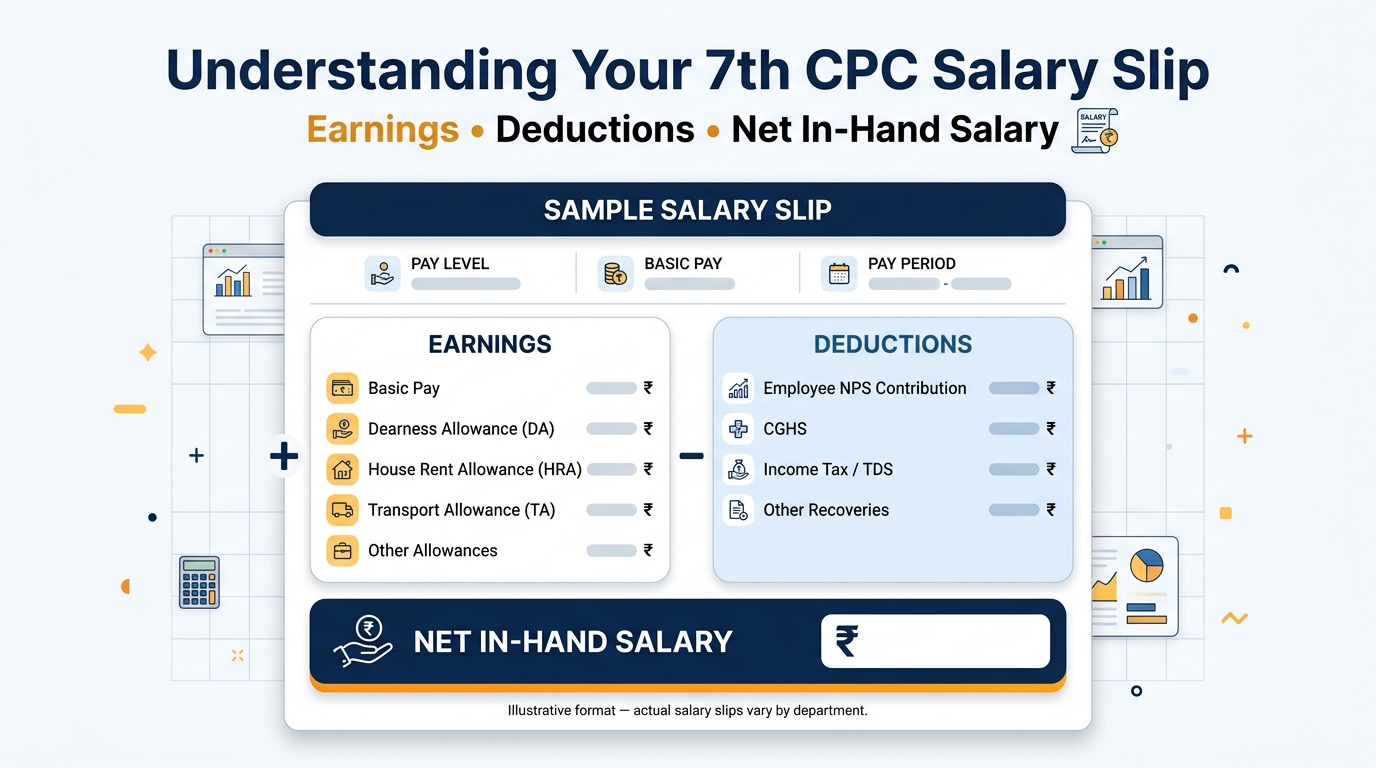
Your salary slip has two sides: earnings (what the government pays) and deductions (what is withheld). Gross minus deductions equals net pay. Here is a realistic slip for our Example B employee — Level 7, cell 5, Y city, 60% DA:
| Earnings | ₹ | Deductions | ₹ |
|---|---|---|---|
| Basic pay | 50,500 | NPS (own share) | 8,080 |
| Dearness Allowance (60%) | 30,300 | CGHS | 650 |
| House Rent Allowance (20%) | 10,100 | CGEGIS | 60 |
| Transport Allowance + DA | 5,760 | Professional tax | 200 |
| Gross earnings | 96,660 | Income-tax (TDS) | 0 |
| Total deductions | 8,990 | ||
| Net pay | 87,670 | ||
Three things to check on every slip: (1) the basic pay matches your matrix cell — increments and fixations are the commonest error source; (2) HRA is zero when you’re in government quarters and full when you’re not; (3) DA is on basic only, while TA carries its own DA line. Anything else — festival advance recovery, GPF/CPF, licence fee — appears under deductions with its own label. For a deeper walkthrough of slip line items, see our salary slip format guide.
7 salary-slip mistakes that cost employees money
Most pay errors are never the matrix — they’re missed updates. Check these seven against your slip once a year:
- DA not updated after a revision. The commonest error. When DA moved 58% → 60% in 2026, slips generated before the DoE OM kept showing 58% until the DDO updated the master. If your DA line doesn’t match the latest announced rate, ask — arrears for the gap months are payable.
- Wrong matrix cell after increment. Your July/January increment should move you exactly one cell right. Compare the basic on your slip with the matrix table in Section 4 — a skipped increment compounds every year after it.
- HRA still paid in government quarters (or denied outside them). Both directions happen. Allotment of quarters must zero out HRA from the allotment month; vacation of quarters must restore it. Licence fee recovery is separate — don’t confuse the two lines.
- TA without DA, or TA at the wrong slab. TA must carry DA at the prevailing rate (TA × 1.60 at 60% DA). Promotions from Level 8 to Level 9 change your TA slab from ₹3,600 to ₹7,200 base — verify the jump happened.
- NPS deducted for OPS employees (or missed for NPS ones). Joining date decides: on/after 1-1-2004 means NPS. A wrong flag in either direction affects both your take-home and your retirement corpus — and the employer’s 14% share.
- Fixation option not exercised on promotion. FR 22’s Option 2 (fixation from next increment date) is worth thousands per month over a career, but it must be opted in writing within the time limit. The default Option 1 is applied silently if you don’t choose.
- MACP upgradation never claimed. At 10, 20 and 30 years without promotion, MACP is due — but in many offices nobody reminds you. Count your own qualifying service and represent in time; delayed claims can mean lost arrears.
Found a mismatch? Write to your DDO/establishment section with the specific DoE order or rule cited — corrections with a rule reference move far faster than verbal complaints.
7th CPC vs 6th CPC: what changed
If you served under both commissions, the 7th CPC felt like a clean-up operation. The 6th CPC ran on pay bands (PB-1 to PB-4) plus grade pay — two numbers you had to combine before any allowance made sense. The 7th CPC replaced both with the single pay matrix: one look-up gives your basic directly.
| Feature | 6th CPC | 7th CPC |
|---|---|---|
| Fitment factor | 1.86 | 2.57 |
| Minimum basic pay | ₹7,000 | ₹18,000 |
| Pay structure | Pay band + grade pay | Pay matrix (levels × cells) |
| Annual increment | 3% of (band pay + GP) | 3% — one matrix cell |
| Allowances | Separate orders per allowance | Rationalised; HRA linked to DA thresholds |
| Maximum basic | ₹90,000 (Apex) | ₹2,50,000 (Level 18) |
The conversion itself was mechanical: 6th CPC basic × 2.57, rounded, then fixed at the equal-or-next-higher matrix cell. Example: a 6th CPC basic of ₹17,140 (₹12,540 band pay + ₹4,600 GP) × 2.57 = ₹44,050 → fixed at Level 7 cell 1, ₹44,900. Arrears for January–July 2016 were paid in August 2016.
Beyond the numbers, the 7th CPC rationalised allowances: dozens of small overlapping allowances were abolished or merged, HRA was linked to DA thresholds (so it now rises automatically as DA crosses 25% and 50%), and TA was restructured around the higher-TPTA city concept. The practical effect is a salary stack with fewer moving parts than the 6th CPC’s — which is why a single calculator can now model it accurately.
8th Pay Commission: what to expect Projections only
The most widely reported projection is a fitment factor of ~1.92 — but no official factor exists. If that scenario held, your 7th CPC basic would roughly multiply by 1.92 to give an indicative new basic:
| Current level/cell | Current basic (₹) | Projected basic @1.92× (₹) |
|---|---|---|
| Level 1, cell 1 | 18,000 | ≈ 34,560 |
| Level 7, cell 1 | 44,900 | ≈ 86,208 |
| Level 10, cell 1 | 56,100 | ≈ 1,07,712 |
Two structural points from past commissions: DA would merge into the new basic and reset to 0% — the “hike” headlines always quote basic pay, while your gross rises less because DA restarts. And implementation is widely discussed for 2026–27, but no date is notified. Model your own scenarios — with allowances, pension and tax — on our 8th pay commission salary calculator, and read the fitment factor explainer for how each scenario changes take-home pay.
हिंदी सारांश — 7वां वेतन आयोग सैलरी एक नज़र में
7वां वेतन आयोग केंद्र सरकार के कर्मचारियों का वर्तमान वेतन ढांचा है। न्यूनतम बेसिक पे ₹18,000 और अधिकतम ₹2,50,000 प्रति माह है। फिटमेंट फैक्टर 2.57 है।
वर्तमान DA 60% है (1 जनवरी 2026 से)। HRA शहर के हिसाब से — X शहर 30%, Y शहर 20%, Z क्षेत्र 10%। ट्रांसपोर्ट भत्ता लेवल 9 से ऊपर X/Y शहर में ₹7,200 और लेवल 1–8 में ₹3,600 है, जिस पर DA भी मिलता है।
NPS में (बेसिक + DA) का 10% कटता है। हर साल 3% इन्क्रीमेंट जनवरी या जुलाई में मिलता है। प्रमोशन पर FR 22 के नियम से वेतन तय होता है। ऊपर दिया गया 7th pay commission salary calculator आपकी इन-हैंड सैलरी तुरंत निकाल देगा — अपना पे-लेवल, सेल और शहर चुनें।
Frequently asked questions (7th CPC salary)
1. What is the minimum salary under the 7th Pay Commission?
The minimum basic pay is ₹18,000 per month (Level 1, cell 1). Total salary is higher: at 60% DA that’s ₹10,800 DA plus HRA per your city class and transport allowance. After NPS (₹2,880) and CGHS (₹250), a Z-city MTS takes home roughly ₹30,350. Your city class moves this figure up or down.
2. What is the maximum salary under the 7th Pay Commission?
The highest basic pay is ₹2,50,000 per month at Level 18 (Apex scale), a single fixed cell with no increments. Posts at this level — such as the Cabinet Secretary — draw this basic plus 60% DA, admissible HRA and allowances, less NPS/CGHS and income tax.
3. How is DA calculated in the 7th Pay Commission?
DA% = [(12-month average of AICPI-IW (base 2001 = 100) − 261.42) ÷ 261.42] × 100. The Labour Bureau publishes the index monthly with a one-month lag. DA is revised twice a year, effective 1 January and 1 July, through DoE orders after Cabinet approval.
4. What is the current DA rate for central government employees?
60% of basic pay, effective 1 January 2026 (Cabinet approval 18 April 2026; DoE OM dated 22 April 2026). The July 2026 revision had not been officially announced as of 19 October 2026 — news reports expected around 63% pending Cabinet approval, but only a notified order counts.
5. How is HRA calculated in 7th CPC?
HRA = basic pay × city-class rate: X cities 30%, Y cities 20%, Z areas 10% (current rates while DA exceeds 50%), subject to minimums of ₹5,400 / ₹3,600 / ₹1,800 per month. No HRA is paid when you occupy government accommodation.
6. What are the Transport Allowance rates in 7th CPC?
Level 9 and above: ₹7,200/month in X/Y cities, ₹3,600 in Z areas. Level 1–8: ₹3,600 in X/Y, ₹1,800 in Z. DA at the prevailing rate is additionally payable on TA. A notified higher-TPTA city list attracts the upper rate.
7. What is the pay matrix? How many levels and cells?
The pay matrix replaced pay bands and grade pay. It has 19 rows — Levels 1 to 18 plus a separate Level 13A — with up to 40 cells per row (Level 18 has one fixed cell). Your basic pay is the figure at your level-row and cell-column; each annual increment moves you one cell right at 3%.
8. My appointment letter says Grade Pay 4200 — what is my level?
Grade Pay ₹4,200 (PB-2) maps to Level 6, entry basic ₹35,400. Caution: old GP ₹5,400 splits by pay band — PB-2 maps to Level 9, PB-3 to Level 10 — so check your pay band too. The full mapping table is in Section 4 above.
9. When is the annual increment given? How much?
One increment of 3% of basic pay per year, granted on 1 January or 1 July as per your option and qualifying service. It moves you exactly one cell down your level’s matrix row — no separate calculation needed.
10. How is pay fixed on promotion?
Under FR 22, you get one increment (3%) in the lower level, then fixation at the next-higher cell in the promoted level. Alternatively, you may opt in writing for fixation from your next increment date — often more lucrative. See the worked Level 6 → Level 7 example in Section 7.
11. What is MACP and who gets it?
The Modified Assured Career Progression scheme grants up to three financial upgradations at 10, 20 and 30 years of service when regular promotion hasn’t happened. Pay moves to the next level’s appropriate cell; designation doesn’t change. Screening and benchmark conditions apply.
12. How much NPS is deducted from salary?
10% of (Basic Pay + DA) every month for employees who joined on or after 1 January 2004; the government adds 14% to your pension account. Pre-2004 joiners under the Old Pension Scheme have no NPS deduction.
13. What is the in-hand salary of Level 7 / Level 10?
At 60% DA in a Y city: Level 7 cell 1 (basic ₹44,900) → gross ≈ ₹86,580, net ≈ ₹78,750 after NPS and CGHS. Level 10 cell 1 (basic ₹56,100) → gross ≈ ₹1,08,100, net ≈ ₹97,850. Enter your exact cell and city in the calculator above for your figure.
14. Do state government employees get 7th CPC?
States decide independently. Many adopted 7th CPC-based structures with their own fitment, dates and allowance orders; others kept older patterns. Always check your state finance department’s pay revision orders — central rates don’t automatically apply.
15. Do pensioners get DA?
Pensioners receive Dearness Relief (DR) at the same percentage as DA — currently 60% of basic pension — revised on the same January/July cycle through separate government orders.
16. What is the salary slip format under 7th CPC?
Earnings side: basic pay, DA, HRA, TA (with DA), other allowances. Deductions side: NPS, CGHS, CGEGIS, professional tax, income-tax/TDS, recoveries. Gross minus deductions = net pay. Section 9 walks through a complete sample slip.
17. How do I convert 6th CPC pay to 7th CPC?
Multiply 6th CPC basic (pay in pay band + grade pay) by 2.57, round to the nearest rupee, and fix at the equal-or-next-higher cell in the corresponding level. Arrears for 1 Jan–31 Jul 2016 were paid in August 2016.
18. Is HRA paid if I live in government quarters?
No. HRA is not admissible when government accommodation is allotted and occupied; licence fee is recovered instead per the accommodation type and city. Tick the quarters checkbox in the calculator to zero out HRA.
19. How much income tax does a government employee pay?
Under the new regime (FY 2025-26), taxable salary income up to ₹12 lakh is effectively tax-free via the 87A rebate, with ₹75,000 standard deduction; slab rates of 5–30% apply above. Actual liability depends on total income, deductions and regime choice — use the calculator’s tax toggle for a rough estimate.
20. What happens to DA when the 8th Pay Commission is implemented?
Following the established pattern, existing DA merges into the revised basic pay and the DA counter restarts from zero. That’s why basic-pay “hike” percentages always look bigger than the actual gross-pay rise. The 8th CPC hasn’t issued recommendations yet.
21. What is the fitment factor of the 7th Pay Commission?
2.57 — applied uniformly to 6th CPC basic pay to produce the 7th CPC matrix entry values. Our fitment factor page explains it in full, including 8th CPC scenarios.
22. Which is better for HRA: X, Y or Z city posting?
X cities pay the highest rate (30%) but usually have the highest rents. Compare actual rent minus HRA received — a Y-city posting with cheap rent can leave more in your pocket than an X-city posting where rent eats the extra HRA.
Latest updates / changelog
- 19 Oct 2026 (this page): DA verified at 60% (DoE OM 22 Apr 2026, effective 1 Jan 2026). July 2026 revision not yet officially announced — page keeps DA editable and date-stamped.
- Jul 2025: DA revised 55% → 58% (Cabinet 1 Oct 2025, effective 1 Jul 2025).
- Jan 2026: DA revised 58% → 60% (Cabinet 18 Apr 2026, effective 1 Jan 2026).
- Jan 2024: DA crossed 50%; HRA rates revised upward to 30% / 20% / 10% (X/Y/Z).
- Sep 2017: Level 13 entry pay modified to ₹1,23,100.
- Jul 2017: Revised HRA/TA allowance orders issued.
Page last updated: 19 October 2026. Rates change with DoE orders — recheck the DA field before relying on a figure.
Related tools
Disclaimer: This page is an informational estimate based on published pay rules. It is not an official government publication. For entitlements, rely on DoE orders and your pay-fixation authority. Official sources: Department of Expenditure (doe.gov.in) · Press Information Bureau (pib.gov.in).